

Carried by 2 nurseries
View Availability at NurseryData provided by the participants of the Consortium of California Herbaria
View additional distribution information on the Jepson eflora
Ceanothus maritimus is a rare, narrow endemic species of shrub in the Buckthorn family (Rhamnaceae) known by the common name Maritime Ceanothus. It is endemic to San Luis Obispo County, California, where it is known from only a few occurrences in the vicinity of Hearst Ranch. It shares the same range as the similarly rare Ceanothus hearstiorum, growing on the coastal bluffs.
This species looks unlike other Ceanothus and is said to resemble the non-native Cotoneaster. This is a spreading or ascending shrub under a meter in height with reddish gray bark aging to gray. The firm evergreen leaves are oppositely arranged, each oval or oblong in shape with a pointed, flat, or notched tip. Its short leaves are shiny green on top and woolly underneath, with their edges curled under and sometimes toothed.
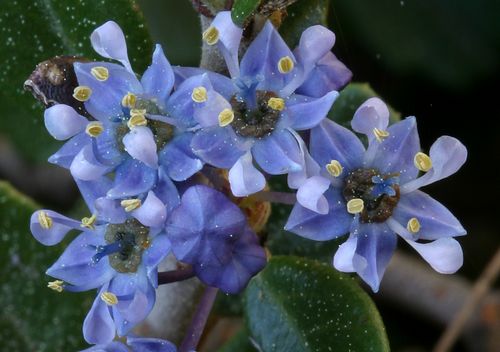
The flower cluster is a small cluster of deep blue to off-white flowers. The fruit is a capsule, generally rounded with tiny horns on top. This is an attractive, adaptable, long-lived plant that is great for central coastal gardens.
Shrub
2 - 3 ft Tall
3 - 8 ft Wide
Mounding, Spreading
Slow
Evergreen
Pleasant, Slight

Blue, White, Green
Winter, Spring
Bank stabilization, Deer resistant, Groundcover
Partial Shade, Full Sun
Low
Max 2x / month once established
Easy
Tolerates cold to -4° F
Fast, Medium, Slow
Normally found on sand sea bluffs, but tolerant of clay or rocky soils. Reported to tolerate high boron soil.
Tolerates saline soil..
Soil PH: 6.0 - 8.0
Tip prune if a compact shape is desired.
For propagating by seed: Hot water treatment.
Slopes and bluffs very near the coast, as part of chaparral or valley grassland, primarily in San Luis Obispo County. However, it is said to do well inland in high shade.
Chaparral, Coastal Sage Scrub, Coastal Strand, Valley Grassland
Chamise (Adenostoma fasciculatum), Coffee Berry (Frangula californica), Toyon (Heteromeles arbutifolia), Iris douglasiana, Coast Twinberry (Lonicera involucrata var. ledebourii), Black Sage (Salvia mellifera), Sticky Monkeyflower (Diplacus aurantiacus) and Lupinus species
Butterflies and moths supported
0 confirmed and 44 likely
Western Avocado Leafroller Moth
Amorbia cuneana