

Carried by 9 nurseries
View Availability at NurseryData provided by the participants of the Consortium of California Herbaria
View additional distribution information on the Jepson eflora
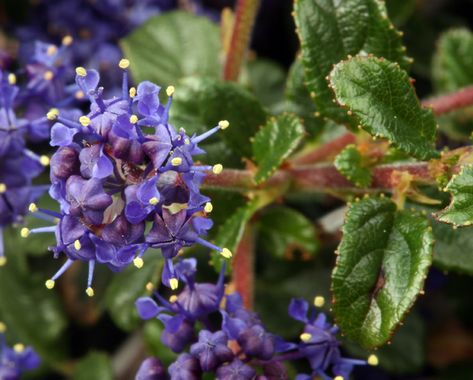
Carmel ceanothus (Ceanothus thyrsiflorus var. griseu) is a flowering shrub available in many named cultivars. In winter to spring its evergreen leaves are densely covered with small blue or purple flowers. This native plant is endemic to coastal California. It grows in the chaparral, coastal scrub, and closed-cone-pine forest plant communities.
The flowers become food sources for larvae of some butterfly and moth species, bees, and other beneficial insects.
Carmel ceanothus is the most popular ceanothus for California garden. Gardeners find it easy to grow and fast-growing. It will take a wide range of soils and can tolerate summer water up to twice a week.
Take care with pruning and do not prune heavily. You should not cut back into old wood. Instead, promote new shoots by pruning the tip of stems where growth is active. Also, you can trim off dead branches on the interior of the shrub to improve its shape and attractiveness.
Cultivars of Carmel ceanothus have variable leaf and flower colors and grow to different heights and widths. Calscape features:
Diamond heights mountain lilac (Ceanothus thyrsiflorus var. griseus 'Diamond Heights')
Kurt Zadnik Carmel ceanothus (Ceanothus thyrsiflorus var. griseus 'Kurt Zadnik')
Louis Edmunds Carmel ceanothus (Ceanothus thyrsiflorus var. griseus 'Louis Edmunds')
Point Sal Carmel creeper (Ceanothus thyrsiflorus var. griseus 'Point Sal')
Santa Ana Carmel ceanothus (Ceanothus thyrsiflorus var. griseus 'Santa Ana')
Yankee Point Carmel Ceanothus (Ceanothus thyrsiflorus var. griseus 'Yankee Point')
Shrub
3 - 15 ft Tall
4 - 15 ft Wide
Mounding, Rounded, Spreading, Upright
Fast
Evergreen
Pleasant

Blue
Spring, Winter
Bank stabilization
Partial Shade
Low
Max 2x / month once established
Easy
Tolerates cold to 15° F
Fast, Medium, Slow
Tolerant of sandy or clay soil.
Soil PH: 5.0 - 7.0
Some cultivars may need annual pruning to maintain desired shape.
Because of the tendency of Ceanothus to hybridize, propagation is usually from cuttings. For propagating by seed: Boil in water 1 minute, cool immediately to room temperature, and sow.
5, 7, 8, 9, 14*, 15*, 16*, 17*, 19*, 20*, 21*, 22*, 23*, 24*
Hills and bluffs, usually within a few miles of the coast, along with Monterey Pine and other trees of the central coast, or with northern coastal scrub
Closed-cone Pine Forest, Coastal Sage Scrub, Northern Coastal Scrub
Woollyleaf Ceanothus (Ceanothus tomentosus), Hoaryleaf Ceanothus (Ceanothus crassifolius), Toyon (Heteromeles arbutifolia), Coffeeberry (Frangula spp.), Oceanspray (Holodiscus discolor), Flannelbush (Fremontodendron spp.), Bush Poppy (Dendromecon rigida), and Honeysuckle (Lonicera spp.)
Butterflies and moths supported
0 confirmed and 80 likely
Sallow Button
Acleris hastiana
Cottonwood Dagger Moth
Acronicta lepusculina
UC Master Gardeners of Sonoma https://sonomamg.ucanr.edu/Plant_of_the_Month/Ceanothus_Wild_Lilac/