

Carried by 4 nurseries
View Availability at NurseryData provided by the participants of the Consortium of California Herbaria
View additional distribution information on the Jepson eflora
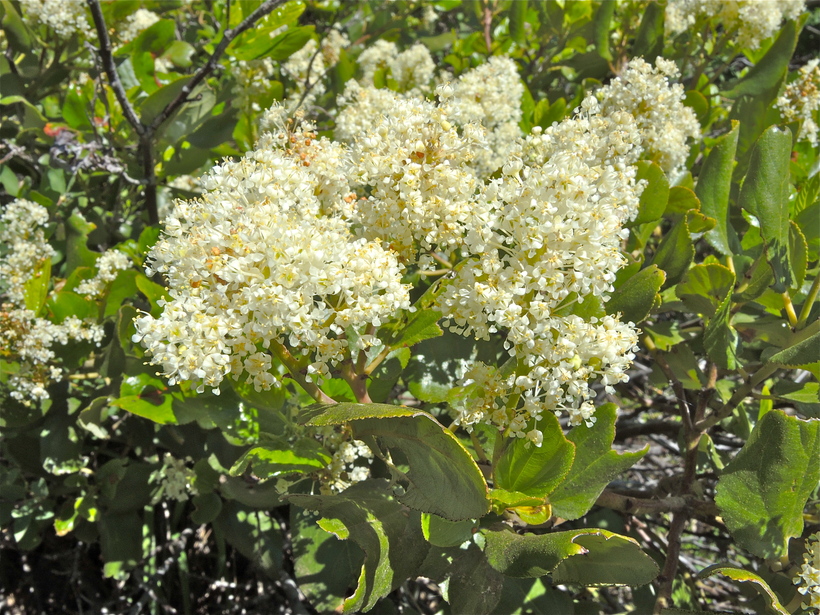
Ceanothus velutinus is a species of shrub in the buckthorn family, Rhamnaceae, known by the common names Red Root, Snowbrush Ceanothus and Tobacco Brush. It is native to western North America from British Columbia to California to Colorado, where it grows in several habitat types including coniferous forest, chaparral, and various types of woodland. In California it is found primarily in the northern half of the state in the Coast Ranges, Sierras, Klamath and Modoc regions. It can grow up to 4 meters tall but generally remains under three, and forms colonies of individuals which tangle together to form nearly impenetrable thickets. The aromatic evergreen leaves are alternately arranged, each up to 8 centimeters long. The leaves are oval in shape with minute hairy teeth along the edges, and shiny green and hairless on the top surface. The plentiful flower clusters are long clusters of white flowers. The fruit is a three-lobed capsule a few millimeters long which snaps open explosively to expel the three seeds onto the soil, where they may remain in a buried seed bank for well over 200 years before sprouting. The seed is coated in a very hard outer layer that must be scarified, generally by wildfire, before it can germinate. Like most other Ceanothus, this species fixes nitrogen via actinomycetes on its roots.
Tree, Shrub
6 - 13 ft Tall
6 - 12 ft Wide
Upright, Mounding
Moderate
Evergreen

White, Green
Summer, Winter, Spring
Hedge
Partial Shade, Full Sun
Very Low
Max 2x / month once established
Tolerates cold to 5° F
Fast, Medium, Slow
Coarse well-drained soils, sandy loams, clay loams, loose or unstable soils.
Soil PH: 6.0 - 7.0
For propagating by seed: Hot water and 2-3 mos. stratification ( USDA Forest Service 1974 ).
1, 2, 6, 7, 15, 16, 17
Openings in wooded slopes of northern California foothills and high mountains, up to 11, 000 ft. as part of montane chaparral or evergreen forest
Chaparral, Lodgepole Forest, Red Fir Forest, Subalpine Forest, Yellow Pine Forest
Trees: White Fir (Abies concolor), Maples (Acer spp.), Alder (Alnus spp.), Incense Cedar (Calocedrus decurrens), Western Juniper (Juniperus occidentalis), Tanoak (Notholithocarpus densiflorus), Pines (Pinus spp.), and Oaks (Quercus spp.)
Shrubs: Manzanita (Arctostaphylos spp.), Oregon Grape (Berberis aquifolium), Spice Bush (Calycanthus occidentalis), and Coffeeberry (Frangula spp.)
Butterflies and moths supported
13 confirmed and 80 likely
The Brown Elfin
Callophrys augustinus
Tamarack Looper
Eupithecia misturata
Elegant Sheepmoth
Hemileuca eglanterina