

Carried by 6 nurseries
View Availability at NurseryData provided by the participants of the Consortium of California Herbaria
View additional distribution information on the Jepson eflora
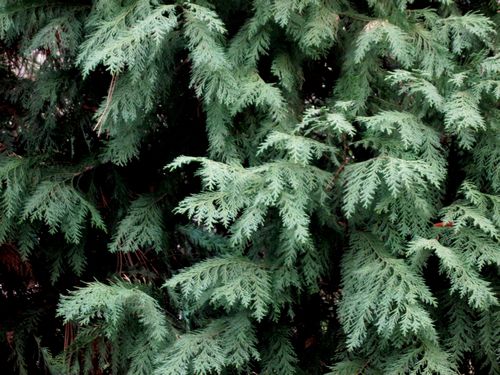
Chamaecyparis lawsoniana is a tree in the family Cupressaceae, known by the name Lawson's Cypress in the horticultural trade, or Port Orford Cedar in its native range (although not a true cedar). C. lawsoniana is native to the southwest of Oregon and the far northwest of California, occurring from sea level up to 1,500 meter (4,900 feet) altitude in mountain valleys, often along streams. It is a large evergreen coniferous tree, regularly reaching 50-70 meter (200 feet) tall, with feathery foliage in flat sprays, usually somewhat waxy pale blue-green in colour. The leaves are scale-like, 3-5 millimeter long, with narrow white markings on the underside, and produced on somewhat flattened shoots. The seed cones are globose, 7-14 millimeter diameter, with 6-10 scales, green at first, maturing brown in early fall, 6-8 months after pollination. The male cones are 3-4 millimeter long, dark red, turning brown after pollen release in early spring. The bark is reddish-brown, and fibrous to scaly in vertical strips. This tree is valued for its wood and is farmed for that purpose. Due to its ultimate size it is not often used in residential gardens.
Tree
40 - 200 ft Tall
26 ft Wide
Pyramidal
Moderate
Evergreen
Pleasant

Blue, Red, Brown
Spring
Deer resistant
Partial Shade
High, Moderate
Max 3x / month once established
Moderate
Tolerates cold to 5° F
Fast, Medium
Prefers moist, well-drained, neutral to slightly acidic soil or sandy and clay loams and rocky ridges.
Dead branches may be pruned, but do not cut into living wood. Prune in winter when wood boring insects are less active.
For propagating by seed: No treatment; stratification may improve germination (USDA Forest Service 1974).
1, 2, 3, 4*, 5*, 6*, 7, 14*, 15*, 16*, 17*, 18, 19, 20, 21, 22, 23, 24
Mountain valleys, often near streams
Douglas-Fir Forest, Mixed Evergreen Forest, North Coastal Coniferous Forest
In the wild it is found in mixed stands with Grand Fir (Abies grandis), Mountain Maple (Acer glabrum), Sitka Spruce (Picea sitchensis), Douglas Fir (Pseudotsuga menziesii), Coast Redwood (Sequoia sempervirens), Western Red Cedar (Thuja plicata), and Western Hemlock (Tsuga heterophylla).
Butterflies and moths supported
0 confirmed and 16 likely
Cypress Tipminer
Argyresthia cupressella
Orange Tortrix Moth
Argyrotaenia franciscana
The Brown Elfin
Callophrys augustinus
Olive Hairstreak
Callophrys gryneus