

Carried by 3 nurseries
View Availability at NurseryData provided by the participants of the Consortium of California Herbaria
View additional distribution information on the Jepson eflora
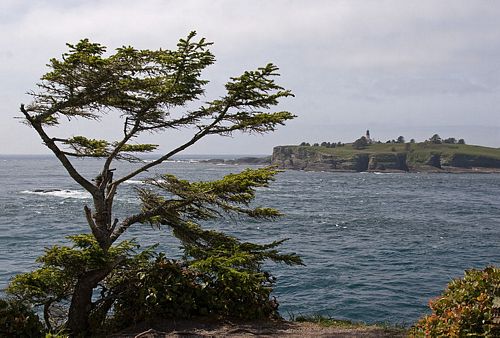
The Sitka Spruce (Picea sitchensis) is a large coniferous evergreen tree growing to 50-70 meter tall, exceptionally to 100 meter tall, and with a trunk diameter of up to 5 meter, exceptionally to 6-7 meter diameter. Native to the northwest coast of North America, primarily Humboldt and Del Norte Counties in California, it is by far the largest species of spruce, and the third tallest conifer species in the world (after Coast Redwood and Coast Douglas-fir). Also, the fourth largest conifer (behind Giant Sequia, Coast and Western Red Cedar). It acquires its name from the community of Sitka, Alaska. The bark is thin and scaly, flaking off in small circular plates 5-20 centimeter across. The crown is broad conic in young trees, becoming cylindric in older trees; old trees may have no branches in the lowest 30-40 meter. The shoots are very pale buff-brown, almost white, and smooth (hairless) but with prominent pulvini. The leaves are stiff, sharp and needle-like, 15-25 millimeter long, flattened in cross-section, dark waxy pale blue-green above with two or three thin lines of stomata, and blue-white below with two dense bands of stomata.
Tree
40 - 230 ft Tall
Pyramidal, Upright
Moderate
Evergreen

Yellow
Spring
Full Sun, Partial Shade
Moderate, High
Max 1x / month once established
Tolerates cold to 20° F
Medium
Prefers rich, forest soil with well-decomposed organic component derived from decaying wood. For garden purposes add redwood compost to soil mix.
Prune in winter when wood boring insects are less active.
For propagating by seed: No treatment. ( USDA Forest Service 1974); 1 mo. stratification ( Babb 1959).
2, 3, 4*, 6*, 7, 14, 15*, 16*, 17*
Moist places near river mouths at lower elevations and usually near the coast, from Ft. Bragg (Mendocino County), California to Kodiak Island, Alaska
Closed-cone Pine Forest, Coastal Strand, North Coastal Coniferous Forest, Forest, Wetland-Riparian
Because of its great size, this tree should be used on large acreage with other species of the north coast such as Cascades Oregon Grape (Berberis nervosa), Water Birch (Betula occidentalis), Bush Chinquapin (Chrysolepis sempervirens), Dwarf Juniper (Juniperus communis), Huckleberry Oak (Quercus vaccinifolium), Stink Currant (Ribes bracteosum), and Western Raspberry (Rubus leucodermis).
Butterflies and moths supported
32 confirmed and 18 likely
Rusty Shoulder Knot Moth
Aseptis binotata
Douglas-Fir Cone Moth
Barbara colfaxiana
Mottled Gray Carpet
Cladara limitaria