

Carried by 3 nurseries
View Availability at NurseryData provided by the participants of the Consortium of California Herbaria
View additional distribution information on the Jepson eflora
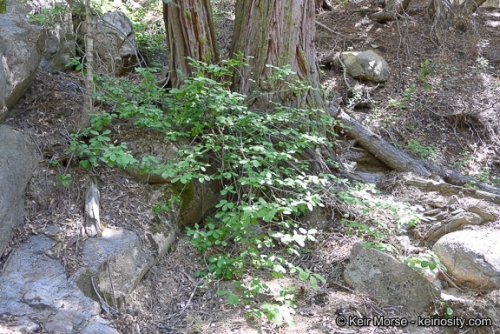
Euonymus occidentalis is a species in the Celastraceae (Bittersweet) family known by the common name Burning Bush. It is native to western North America from British Columbia to California, where it is the only member of its genus growing wild. In California it is found in two disjunct locations corresponding to its two recognized Varieties: Var. occidentalis is found along the coast from Santa Cruz northward, and in the Cascades and Sierra foothills. Var. parishii is found far to the south in the Peninsular Range. Though not designated as rare, it is a somewhat uncommon plant growing as a shrub or small tree reaching maximum heights from two to six meters. The thin, green, oval-shaped leaves are up to one and a half centimeters long and sometimes rolled under along the edges. The flower cluster holds up to five small flowers at the end of a long peduncle. Each flower has five rounded, mottled petals of red, pink, brown or white color, around a central nectar disc with 5 nubs. The fruit is a rounded red-orange capsule with three bulging lobes. It opens to reveal one seed in each of the three lobes. The seed in concealed in a red aril. Although this plant likes moist locations, it also needs good drainage. Burning Bush is a good choice for cool, shaded woodland gardens or higher elevation, forested gardens.
Shrub
7 - 20 ft Tall
10 - 20 ft Wide
Mounding
Winter Deciduous

Brown, Pink, Red, White
Spring
Hedge
Deep Shade, Partial Shade
Moderate
Max 1x / month once established
Tolerates cold to 5° F
Fast, Medium
Prefers fine sandy or silty loam.
For propagating by seed: 3 mos. stratification.
Stream banks, forested canyons and other moist, shaded places at elevations from sea level to 7, 000 ft.
Closed-cone Pine Forest, Mixed Evergreen Forest, Forest, Yellow Pine Forest
Use with other forest/woodland species including Maples (Acer macrophyllum and circinatum), Red Alder (Alnus rubra), Serviceberry (Amelanchier alnifolia), Douglas Fir (Pseudotsuga menziesii), Oaks (Quercus spp.), Coast Redwood (Sequoia sempervirens), Western Red Cedar (Thuja plicata), and native ferns
Butterflies and moths supported
0 confirmed and 3 likely
The Small Engrailed
Ectropis crepuscularia
Fall Webworm
Hyphantria cunea
Three-Lined Leafroller Moth
Pandemis limitata