

Carried by 18 nurseries
View Availability at NurseryData provided by the participants of the Consortium of California Herbaria
View additional distribution information on the Jepson eflora
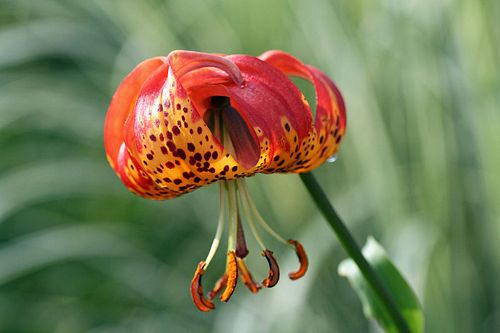
Lilium pardalinum, sometimes known as the panther lily or leopard lily, is a native of Oregon and California, where it usually grows in damp areas. In California it is found primarily in the central to northern part of the state in the Coast Ranges, Klamath mountains and Sierras. Typically it grows to about two meters high, the tallest and most vigorous plants can reach up to 2.5 meters. The flowers are Turk's-cap shaped, red-orange, with numerous brown spots, usually flowering in July. The plant grows from bulbs which are small, and many are usually clustered together on a rhizomatous stock.
There are 5 recognized subspecies, three of which are rare. The growing requirements of all are similar.
Perennial herb, Geophyte
7 - 8 ft Tall
6 in Wide
Weeping
Winter Deciduous

Orange, Red, Brown
Summer
Partial Shade, Full Sun
Low, Moderate, Very Low
Max 1x / week once established
Tolerates cold to -15° F
Slow
Tolerates a variety of soils including clay and serpentine and acidic soils.
Tolerates serpentine soil..
Soil PH: 4.0 - 8.0
Do not prune or trim until after it has finished blooming for the year and the stalk becomes completely dry
For propagating by seed: Sow outdoors in summer for germination the following spring, or 3-6 mos. warm then 2-3 mos. cold stratification. For forcing slightly green or fresh seeds: 6-8 wks. warm (70°F) stratification or until the majority of seeds have formed bulblets; then 4-6 wks. cold (about 35°FJ stratification; sow, and at 55 to 60°F leaves should be produced in 4-6 wks. (De Graaff 1951).
Moist places such as along stream banks, lake shoreline, or near seeps or springs
Mixed Evergreen Forest, North Coastal Coniferous Forest, Yellow Pine Forest, Wetland-Riparian
Trees: Coast Redwood (Sequoia sempervirens), Pines (Pinus spp.), Madrone (Arbutus menziesii), Incense Cedar (Calocedrus decurrens), Coast Silktassel (Garrya elliptica), Tanoak (Notholithocarpus densiflorus), Douglas Fir (Pseudotsuga menziesii), Oak (Quercus spp.), California Laurel (Umbellularia californica), and others
Shrubs/herbs: Oneleaf Onion (Allium unifolium), Manzanita (Arctostaphylos spp.), Barberry (Berberis spp.), Mariposa Lily (Calochortus spp.), Ceanothus spp., Miner's Lettuce (Claytonia perfiolata), Yerba Buena (Clinopodium douglasii), Larkspur (Delphinium spp.), Crevise Alumroot (Heuchera micrantha), Iris spp., Pink Honeysuckle (Lonicera hispidula), Lupine (Lupinus spp.), Currant (Ribes spp.), Trillium spp., Triteleia spp., and Viola spp.
Butterflies and moths supported
0 confirmed and 3 likely
Reaper Dart
Euxoa messoria
Figwort Stem Borer
Papaipema sauzalitae
Virginian Tiger Moth
Spilosoma virginica