

Carried by 28 nurseries
View Availability at NurseryData provided by the participants of the Consortium of California Herbaria
View additional distribution information on the Jepson eflora
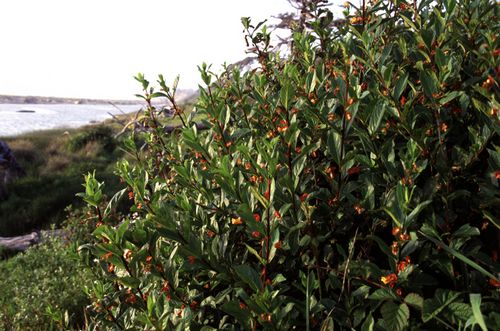
Twinberry (Lonicera involucrata) is a member of the Honeysuckle (Caprifoliaceae) family that is native to northern and western North America, from southern Alaska to Quebec, and south through the western United States to California and to Chihuahua in northwestern Mexico.
It is a large shrub with elliptical leaves. Its flowers are tubular, hairy, 1-2 centimeter long. They are produced in pairs; each pair has a pair of reddish basal leaves. The fruit is a black berry 1/4 to 1/2 inch in diameter; each contains several small seeds.The fruit is edible but bitter and best left to the birds.
In California the two recognized varieties have differing ranges. Var. involucrata has mostly yellow flowers and is found in the Sierra. Var. ledebourii has mostly red-orange flowers and is found along the coast and in the Coast Ranges from Santa Barbara County northwards. It grows at elevations from sea level to 9500 ft.
In the garden, this plant likes regular water but can survive on reduced watering. The flowers are welcome in summer when many other plants have finished blooming.
Shrub
2 - 16 ft Tall
3 - 4 ft Wide
Upright
Moderate
Winter Deciduous

Red, Orange, Yellow
Summer
Hedge
Full Sun, Partial Shade
Low, Moderate
Max 1x / week once established
Easy
Tolerates cold to -20° F
Fast
Prefers moist, sandy soil.
Soil PH: 4.0 - 7.0
Moist places
Closed-cone Pine Forest, Coastal Strand, Lodgepole Forest, Red Fir Forest, Subalpine Forest, Wetland-Riparian
Trees: Fir (Abies spp.), Giant Chinquapin (Chrysolepis chrysophylla), Monterey Cypress (Hesperocyparis macrocarpa), Tanoak (Notholithocarpus densiflorus), Pines (Pinus spp.), Spruce (Picea spp.), Cottonwood/Aspen (Populus spp.), Oak (Quercus spp.)
Shrubs: Manzanita (Arctostaphylos spp.), Oregon Grape (Berberis spp.), Ceanothus spp., Dogwood (Cornus spp.), Silk Tassel Bush (Garrya elliptica or fremontii), Ninebark (Physocarpus capitatus), Currant (Ribes spp.), Huckleberry (Vaccinium spp.)
Butterflies and moths supported
0 confirmed and 25 likely
Geranium Plume Moth
Amblyptilia pica
Western Avocado Leafroller Moth
Amorbia cuneana
Garden Tiger Moth
Arctia caja
Orange Tortrix Moth
Argyrotaenia franciscana
Darris, Dale. Plant Fact Sheet for Twinberry Honeysuckle (Lonicera involucrata). USDA Natural Resources Conservation Service, Corvallis Plant Materials Center, September 2011. PLANTS Database, U.S. Department of Agriculture, https://plants.usda.gov/DocumentLibrary/factsheet/pdf/fs_loin5.pdf. Accessed 20 Aug. 2025.