

Carried by 1 nurseries
View Availability at NurseryData provided by the participants of the Consortium of California Herbaria
View additional distribution information on the Jepson eflora
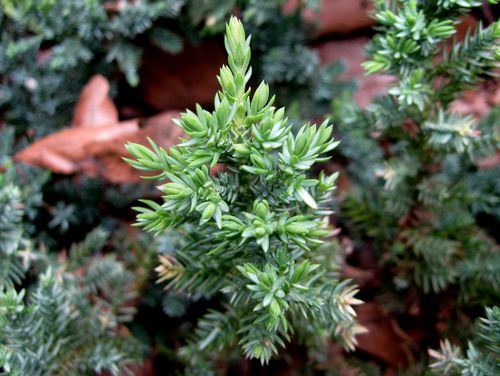
Juniperus communis, Dwarf or Common Juniper, is a species in the genus Juniperus, in the family Cupressaceae. It has the largest range of any woody plant, throughout the cool temperate Northern Hemisphere from the Arctic south in mountains to around 30N latitude in North America, Europe and Asia. It is found in the understory of forests and woodlands, and also beyond the northern limit of trees. In California it is found in the Sierras and in Del Norte and Siskyou Counties. It is a shrub or small tree, highly variable and usually a low spreading shrub, but occasionally reaching 10 meter tall. Common Juniper has needle-like leaves in whorls of three; the leaves are green, with a single white band on the inner surface. It is dioecious, with male and female cones on separate plants, which are wind pollinated. The seed cones are berry-like, green ripening in 18 months to purple-black with a blue waxy coating; they are spherical, 4-12 millimeter diameter, and usually have three (occasionally six) fused scales, each scale with a single seed. The seeds are dispersed when birds eat the cones, digesting the fleshy scales and passing the hard seeds in their droppings. The male cones are yellow, 2-3 millimeter long, and fall soon after shedding their pollen in March-April.
Dwarf Juniper makes an attractive accent in woodland gardens. Although it is native to higher elevations, it appears to accept lower elevation as long as adequate water is provided.
Tree, Shrub
5 - 33 ft Tall
8 ft Wide
Upright, Spreading
Slow
Evergreen

Yellow
Spring
Bank stabilization, Deer resistant
Partial Shade
Low, Moderate
Max 3x / month once established
Easy
Tolerates cold to -15° F
Medium
Prefers somewhat acidic forest soils.
Soil PH: 5.0 - 7.6
Can be tip pruned at any time to control its spread
1*, 2*, 3*, 4*, 5*, 6*, 7, 14, 15*, 16, 17, 18, 19, 20, 21, 22, 23
Rocky or wooded slopes
Douglas-Fir Forest, Lodgepole Forest, North Coastal Coniferous Forest, Subalpine Forest, Yellow Pine Forest
Trees: Ponderosa Pine (Pinus ponderosa), Douglas-fir (Pseudotsuga menziesii), Lodgepole Pine (Pinus contorta), Limber Pine (P. flexilis), White Fir (Abies concolor), Engelmann Spruce (Picea engelmannii), Quaking Aspen (Populus tremuloides), Whitebark Pine (Pinus albicaulis), Subalpine Fir (A. lasiocarpa)
Other forest/woodland species: Big Sagebrush (Artemisia tridentata), Currant/Gooseberry (Ribes spp.), Mountain Mint (Monardella odoratissima), Buckwheat (Eriogonum spp.), snowberry (Symphoricarpos spp.), Oregon Grape (Berberis aquifolium), Silver Lupine (Lupinus argenteus), and Trillium spp.
Butterflies and moths supported
1 confirmed and 23 likely
The Brown Elfin
Callophrys augustinus
Olive Hairstreak
Callophrys gryneus