

Carried by 5 nurseries
View Availability at NurseryData provided by the participants of the Consortium of California Herbaria
View additional distribution information on the Jepson eflora
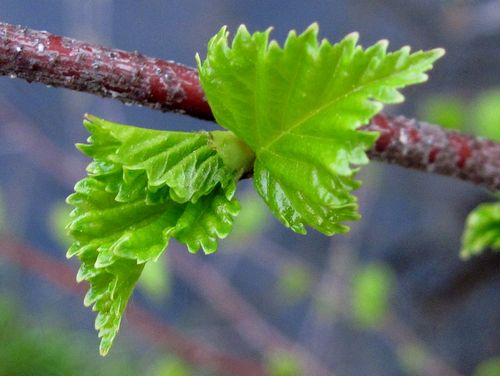
Betula occidentalis (Water Birch) is a species in the Betulaceae family native to western North America. In California its distribution is somewhat patchy, being found in the southern Sierras, Siskiyu and Modoc counties. It typically occurs along streams in mountainous regions from 2,000 ft. to over 11,000 ft. It is a deciduous shrub or small tree growing to 10 meter high, usually with multiple trunks. The bark is dark red-brown to blackish, and smooth but not exfoliating. The twigs are smooth or thinly hairy and have prominent resinous glands but are odorless when scraped. The leaves are alternate, ovate to rhombic, 1-7 centimeter long and 1-4.5 centimeter broad, with a serrated margin and two to six pairs of veins, and a short petiole up to 1.5 centimeter long. The flowers are wind-pollinated catkins 2-4 centimeter long, the male catkins pendulous, the female catkins erect. The fruit is 2-3 centimeter long and 8-15 millimeter broad, composed of numerous tiny winged seeds packed between the catkin leafs. It is amenable to garden conditions and can be used outside its range in the wild. It has good fall color especially where fall weather is colder.
Tree
25 - 33 ft Tall
25 ft Wide
Upright
Moderate, Fast
Winter Deciduous

Yellow, Green
Spring
Containers
Deep Shade, Partial Shade
High
Max 3x / month once established
Easy
Tolerates cold to -10° F
Medium
Prefers coarse-textured, moist to wet soils.
Soil PH: 5.0 - 7.0
Prune to shape in late fall as soon as leaves have dropped
For propagating by seed: 3 mos. stratification. No treatment. with light during germination may give equally good results (Association of Official Seed Analysts 1981; USDA Forest Service 1974).
1*, 2*, 3*, 4, 5, 6, 7*, 9*, 10*, 14, 15, 16, 17, 18*, 19*, 20, 21, 22, 23, 24
Streamsides, springs of medium to high elevation mountains
Lodgepole Forest, North Coastal Coniferous Forest, Red Fir Forest, Yellow Pine Forest, Wetland-Riparian
Trees - Coast Redwood (Sequoia sempervirens), Santa Lucia Fir (Abies bracteata), Douglas Fir (Pseudotsuga menziesii), and many others.
Shrubs and herbs - Meadow Rue (Thalictrum fendleri), Snowdrop Bush (Styrax redivivus), Yellow Monkeyflower (Erythranthe guttata), Western Azalea (Rhododendron occidentale), and Huckleberry (Vaccinum ovatum), Yerba Mansa (Anemopsis californica), wild rose (Rosa californica), and Hedge Nettle (Stachys bullata).
Butterflies and moths supported
5 confirmed and 81 likely
Dark Marbled Carpet
Dysstroma citrata
Ceanothus Silkmoth
Hyalophora euryalus
Pandemis Leafroller
Pandemis pyrusana