

Carried by 27 nurseries
View Availability at NurseryData provided by the participants of the Consortium of California Herbaria
View additional distribution information on the Jepson eflora
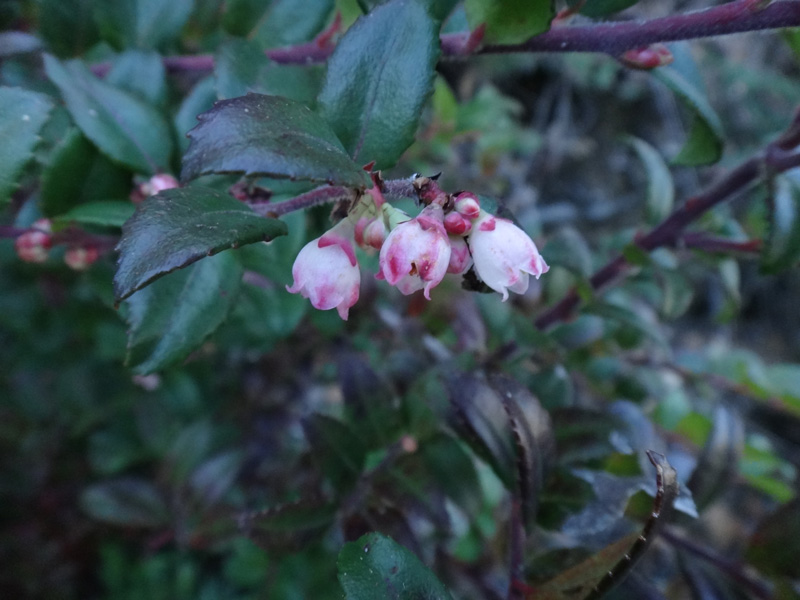
With its dark, evergreen leaves and reddish bark, this attractive native shrub provides year-round interest in the garden. It is also an important wildlife plant. The berries are a food source for a variety of birds and mammals. The delicate, bell-shaped flowers attract bees and hummingbirds.
Evergreen Huckleberry grows in coastal California. In the garden, it is a slow-growing, medium-sized shrub that can serve as a hedge or groundcover. It is a low-water plant that tolerates nutrient-poor soil and shady conditions.
Shrub
2 - 8 ft Tall
15 ft Wide
Upright, Spreading
Slow
Evergreen

White, Blue, Black
Spring, Winter
Containers, Hedge
Partial Shade, Full Sun
Moderate
Max 3x / month once established
Moderate
Tolerates cold to 10° F
Fast, Medium, Slow
Tolerates sand and clay, usually low in organic content.
Soil PH: 4.8 - 6.8
For propagating by seed: No treatment; 1-2 mos. Stratification may improve germination. Sow on milled sphagnum moss or peat moss and sand mix. Also may be propagated by cuttings or layering.
4*, 5*, 6, 7, 14, 15*, 16*, 17, 22, 23, 24
Edges or clearings in forest and woodland
Closed-cone Pine Forest, Mixed Evergreen Forest, Forest
Use with Woolly Leaf Manzanita (Arctostaphylos tomentosa), Glossyleaf Manzanita (Arctostaphylos nummularia), Redwood Manzanita (Arctostaphylos coluumbiana), Bush Anemone (Carpenteria californica), Salal (Gaultheria shallon), Crevice Alumroot (Heuchera micrantha), Bull Pine (Pinus ponderosa), Douglas Fir (Pseudotsuga menziesii), Western Azalea (Rhododendron occidentale), Red Flowering Currant (Ribes sanguineum) and Yerba Buena (Clinopodium douglasii)
Butterflies and moths supported
4 confirmed and 50 likely
Vaccinium ovatum. (n.d.). Www.fs.usda.gov. Retrieved October 18, 2023, from https://www.fs.usda.gov/database/feis/plants/shrub/vacova/all.html