

Carried by 5 nurseries
View Availability at NurseryData provided by the participants of the Consortium of California Herbaria
View additional distribution information on the Jepson eflora
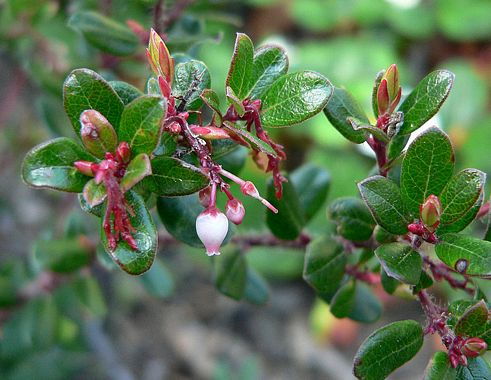
Arctostaphylos nummularia is a species of manzanita known by the common name glossyleaf manzanita. It is endemic to California, where it grows in the forests of the coastal and inland ranges north of the San Francisco Bay. This is a red-barked shrub reaching a maximum height up to five meters. The smaller twigs are covered lightly in white hairy bristles. The leaves are oval-shaped to nearly round, one to two centimeters long and wide. The edges are very finely toothed to nearly smooth, lined with tiny bristles, and sometimes curled under. The upper surface of the leaf is darker green and shinier than the underside. The flower cluster holds a cluster of hanging flowers, which are spherical and white to pink-tinged. The fruit is a cylindrical drupe less than half a centimeter long containing a few seeds.
There are two subspecies; ssp. mendocinoensis (Pygmy Manzanita) was formerly considered a separate species. It is now considered a subspecies of nummularia but rare due to its extremely restricted range, a tiny population on the coast between Ft. Bragg and Albion. As a garden plant it may be difficult unless you can replicate conditions from its native area.
Shrub
5 - 16 ft Tall
5 - 15 ft Wide
Mounding
Moderate
Evergreen
None, Slight

White, Pink
Winter, Spring
Deer resistant
Partial Shade, Full Sun
Moderate
Max 1x / month once established
Tolerates cold to 30° F
Medium
Deep, high organic content, acidic woodland soil.
Soil PH: 4.0 - 6.0
5, 14, 15, 16, 17*
Clearings in coastal chaparral or coniferous woodlands of northern California where summers are cool and foggy, winters are mild and soil is acidic
Chaparral, Closed-cone Pine Forest
Thrift Seapink (Armeria maritima), Ceanothus species, Giant Chinquapin (Chrysolepis chrysophylla), Yerba Buena (Clinopodium douglasii), Woodland Strawberry (Fragraria vesca), Gowen Cypress (Hesperocyparis goveniana), Monterey Cypress (Hesperocyparis macrocarpa), Alumroot (Heuchera spp.), Twinberry (Lonicera involucrata), Lodgepole Pine (Pinus contorta), Bishop Pine (Pinus muricata), Monterey Pine (Pinus radiata), Yellow-eyed Grass (Sisyrinchium californicum), Western Hemlock (Tsuga heterophylla), California Huckleberry (Vaccinium ovatum), and Redwood Violet (Viola sempervirens).
Butterflies and moths supported
0 confirmed and 46 likely
Western Avocado Leafroller Moth
Amorbia cuneana
Miranda Underwing
Amphipyra pyramidoides