

Carried by 5 nurseries
View Availability at NurseryData provided by the participants of the Consortium of California Herbaria
View additional distribution information on the Jepson eflora
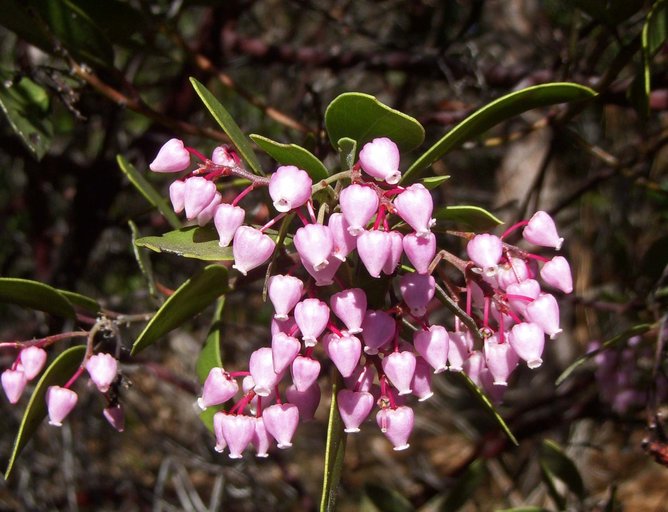
Arctostaphylos stanfordiana is a species in the Ericaceae (Heath) family known by the common name Stanford's manzanita. It is endemic to California, in the outer North Coast Ranges north of the San Francisco Bay Area. This is a bushy shrub growing one half meter to two meters in height. Leaves are oblong to widely lance-shaped, shiny green, and up to 5 centimeters long. The flower cluster is a loose cluster of urn-shaped manzanita flowers which are pink, with some so pale that they are nearly white. The fruit is an oblong drupe about 7 millimeters wide. In the garden this Manzanita is very versatile, being tolerant of a variety of soils (including serpentine) and climates. It has especially attractive bark. Baker's Manzanita was formerly considered a subspecies of stanfordiana, and some sources may still refer to it that way; however, Arctostaphylos bakeri is now considered a separate species. Stanfordiana still has 2 recognized subspecies, decumbens and raichei, both of which are rare in the wild.
Shrub
4 - 9 ft Tall
6 ft Wide
Rounded
Evergreen

Pink, White
Winter, Spring
Hedge
Partial Shade
Low, Very Low
Max 2x / month once established
Easy
Tolerates cold to 5° F
Medium, Slow
Tolerates clay soil.
Tolerates serpentine soil..
Soil PH: 5.0 - 7.5
Takes pruning well and can be shaped into a hedge. Prune in late summer to avoid infection
Seeds or cuttings
Slopes, ridges and canyons of the northern Coast Ranges
Chaparral, Mixed Evergreen Forest
In the wild it occurs with California Barberry (Berberis pinnata), various Ceanothus spp., California Coffeeberry (Frangula californica), Silktassel (Garrya elliptica or fremontii), Oceanspray (Holodiscus discolor), Tanoak (Notholithocarpus densiflorus), Gooseberry (Ribes spp.), Snowberry (Symphoricarpos spp.), and California Wild Grape (Vitis californica). Can also be used with virtually any native chaparral plants
Butterflies and moths supported
0 confirmed and 43 likely
Western Avocado Leafroller Moth
Amorbia cuneana
Miranda Underwing
Amphipyra pyramidoides