

Carried by 49 nurseries
View Availability at NurseryData provided by the participants of the Consortium of California Herbaria
View additional distribution information on the Jepson eflora
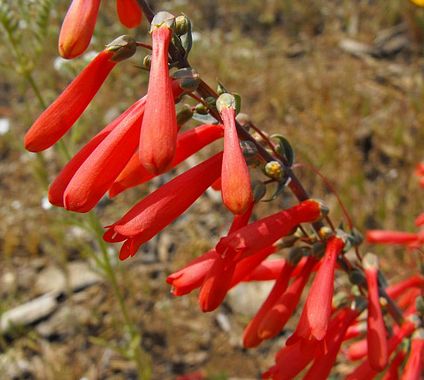
Scarlet bugler (Penstemon centranthifolius) is a striking perennial herb in the plantain family (Plantaginaceae), known for its bright red to orange-red tubular flowers that are irresistible to hummingbirds. Native to California, it grows widely across northern, southern, and central regions.
This drought-adapted plant thrives in rocky, well-drained soils, making it a perfect addition to rock gardens, slopes, and pathways. It requires little supplemental water once established and blooms profusely in the spring. The upright, slender stems can reach over a meter in height, with thick, smooth leaves arranged in pairs along the stem.
Beyond hummingbirds, scarlet bugler also attracts bees and butterflies, contributing to a vibrant and pollinator-friendly garden. Its vivid flowers and minimal water needs make it an excellent choice for low-maintenance native plant landscapes.
Perennial herb
2 - 4 ft Tall
1 ft Wide
Summer Deciduous

Red
Summer, Spring
Containers, Deer resistant
Full Sun, Partial Shade
Low
Max 2x / month once established
Moderate
Tolerates cold to 15° F
Fast, Medium, Slow
Tolerates clay.
Soil PH: 6.0 - 8.0
For propagating by seed: No treatment.
Openings in chaparral, slight slopes and flats, open areas in woodlands, seasonally moist meadows up to 6, 500 ft.
Chaparral, Oak Woodland
Many companion plants including: Chamise (Adenostema fasciculatum), Manzanita (Arctostaphylos spp.), Ceanothus species, Bush Poppy (Dendromecon rigida), Sugarbush (Rhus ovata), Hollyleaf Cherry (Prunus ilicifolia), Bladderpod (Peritoma arborea), Mountain Mahogany (Cercocarpus spp.), Sages (Salvia spp.), California fuchsia (Epilobium canum), Yucca (Hesperoyucca spp. and Yucca spp.), succulents such as Dudleya spp., and various cactus species
Butterflies and moths supported
0 confirmed and 14 likely
Geranium Plume Moth
Amblyptilia pica
Verbena Bud Moth
Endothenia hebesana
Anicia Checkerspot
Euphydryas anicia