

Carried by 5 nurseries
View Availability at NurseryData provided by the participants of the Consortium of California Herbaria
View additional distribution information on the Jepson eflora
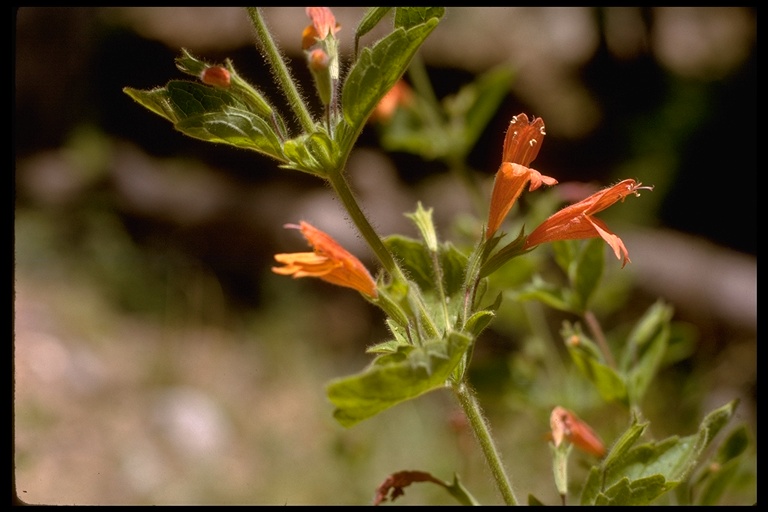
Monkey Flower Savory is a rare native perennial herb in the Lamiaceae (Mint) family that grows in the Coast Ranges from Monterey southward to the Transverse Range. The majority of its population lies within the Los Padres National Forest. It is uncommon throughout its range and for this reason it is included on CNPS list 4.2. It tends to grow in moist places, at elevations from 400 to over 5,000 feet. Like others in this genus, it is low-growing and delicate in appearance, but older specimens in the wild can attain nearly 2 meters. It is herbaceous with slender stems but occasionally woody at the base. The flowers are small, hairy, with a rounded-toothed margin. The tubular flowers are red-orange and grow to 1-2 inches. Hummingbirds love them! Overall, it resembles an Epilobium but requires more moisture. It spreads by rhizomes wherever there is adequate moisture.
Perennial herb
1 - 6 ft Tall
1 - 6 ft Wide
Mounding
Moderate
Winter Deciduous
Pleasant

Orange, Red
Summer, Fall
Deer resistant
Full Sun, Partial Shade
Moderate
Max 1x / week once established
Moderate
Tolerates cold to 25° F
Medium, Slow
Tolerates a variety of soils.
Soil PH: 6.0 - 8.0
Can be cut back in fall when it starts to go dormant
For propagating by seed: No treatment.
5*, 6, 7*, 8*, 9*, 10, 14*, 15*, 16*, 17*, 18, 19*, 20*, 21*, 22*, 23*, 24*
Moist places in hilly or mountainous terrain, along streambanks or in canyons as part of chaparral or woodland
Chaparral, Douglas-Fir Forest
Use in the understory of central coast trees such as Madrone (Arbutus menziesii), Pines (Pinus spp.), and Douglas Fir (Pseudotsuga menziesii), with other perennial herbs, annuals, or geophytes including Yarrow (Achillea millefolium), wild onion (Alium spp.), Columbine (Aquilegia formosa), Mariposa Lily (Calochortus spp.), Clarkia spp., Chinese Houses (Collinsia spp.), Larkspur (Delphinium spp.), Sticky Cinquefoil (Drymocallis glandulosa), Wild Strawberry (Fragraria vesca), Gilia spp., Alum Root (Heuchera micrantha), Iris spp., Tiger Lily (Lilium pardalinum), Lupine (Lupinus spp.), Mint (Monardella spp.), Phacelia spp., Common Buttercup (Ranunculus californicus), Sonoma Sage (Salvia sonomensis), and Western Vervain (Verbena lasiostachys)
Butterflies and moths supported
0 confirmed and 1 likely
Florida Pink Scavanger Caterpillar
Pyroderces badia