

Carried by 14 nurseries
View Availability at NurseryData provided by the participants of the Consortium of California Herbaria
View additional distribution information on the Jepson eflora
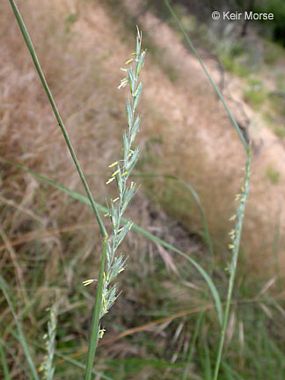
Elymus triticoides is species in the Poaceae (Grass) family known by the common names Creeping Wild Rye and Beardless Wild Rye. It is native to western North America from British Columbia to Texas, where it often grows in moist habitat, sometimes with heavy and saline soils. It forms a solid, rhizomatous root system which allows it to grow at water's edge and prevent the soil from eroding. It reaches 1.3 meters in maximum height with stiff, slender green to blue-green leaves that stand away from the stems at an obvious angle. The flower cluster is a narrow spike up to 20 centimeters long. This grass is not frequently used in residential gardens, but it is a good range land grass for grazing, and it is used to stabilize waterways because of its soil-retaining rhizome network.
Grass
2 - 4 ft Tall
Fast
Winter Deciduous

Green
Groundcover
Partial Shade
Low
Max 1x / month once established
Easy
Tolerates cold to 0° F
Medium, Slow
Tolerates most soils.
Tolerates sodic soil..
Soil PH: 6.0 - 9.0
For propagating by seed: No treatment. Germination may be poor.
1, 2*, 3*, 4, 5*, 6*, 7*, 8*, 9*, 10*, 11, 14*, 15*, 16*, 17*, 18*, 19*, 20*, 21*, 22*, 23*, 24*
Moist, often saline, meadows and understory of various woodlands
Chaparral, Foothill Woodland, Lodgepole Forest, Red Fir Forest, Subalpine Forest, Valley Grassland, Yellow Pine Forest, Wetland-Riparian
Use under Oaks (Quercus spp.), Cottonwoods (Populus spp.), Sycamores (Platanus racemosa) and Willows (Salix spp.) along with Milkweed (Asclepias spp.), Seaside Daisy (Erigeron spp.), Coffeeberry (Frangula spp.), Toyon (Heteromeles arbutifolia), Vervain (Verbena lasiostachys), and Hollyleaf Redberry (Rhamnus ilicifolia).
Butterflies and moths supported
0 confirmed and 10 likely
Glassy Borer
Apamea devastator
Nevada Skipper
Hesperia nevada