

Carried by 10 nurseries
View Availability at NurseryData provided by the participants of the Consortium of California Herbaria
View additional distribution information on the Jepson eflora
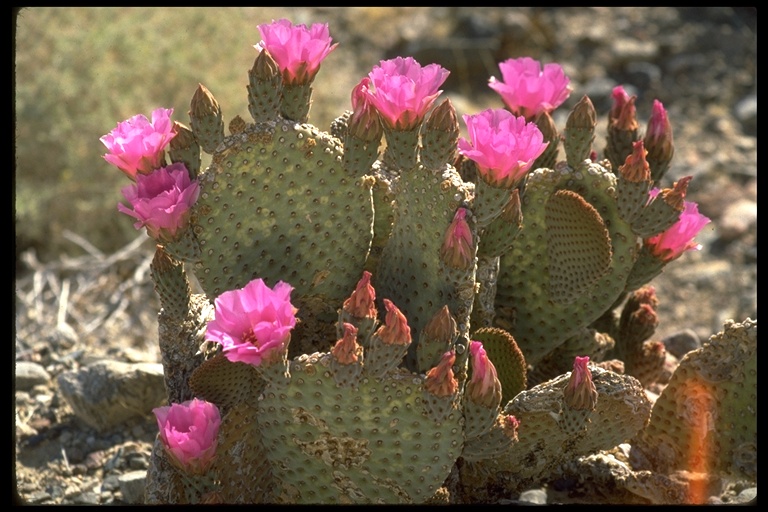
Named for its broad, flat leaf pads, Beavertail Pricklypear (Opuntia basilaris) is a medium sized cactus that's known for its vibrant magenta flowers. While the pads do not have the long spines of other cactus species, they do have small barbs that can be painful when touched. Beavertail Pricklypear blooms profusely in spring and early summer. The bright flowers attract pollinators and provide visual interest in a xeric landscape.
This succulent is native to the Southwestern desert regions of the US. It also grows in Mexico where it is called Nopal. Indigenous peoples consumed the fruit, leaf pad buds, and seeds. Beavertail Pricklypear requires minimal supplemental irrigation. Plant in full sun in sandy, well-draining soil. This cactus grows in clusters that can spread up to 6 ft wide. The pads can shrivel in the summer but will plump up during the winter rainy season. Dead pads can be removed, otherwise little maintenance is needed.
Shrub, Succulent
1 - 2 ft Tall
5 ft Wide
Spreading
Slow
Evergreen
Slight

Pink, Purple, Red
Spring
Hedge
Full Sun, Partial Shade
Extremely Low, Very Low
Never irrigate once established
Moderate
Tolerates cold to 0° F
Fast
Sandy or gravelly, decomposed granite or sandstone.
Soil PH: 6.2 - 8.2
Pruning is generally not needed, although dead pads can be removed to maintain a neater appearance. Always were gloves when working on or around the plant
For propagating by seed: No treatment.
High and low desert, in sandy valley floors, alluvial fans, and rocky slopes and canyons
Chaparral, Coastal Sage Scrub, Creosote Bush Scrub, Joshua Tree Woodland, Pinyon-Juniper Woodland, Southern Oak Woodland, Valley Grassland
This cactus can be used with a wide variety of other plants as long as drainage is fast and supplemental watering is minimized. Good companions could include Desert Agave (Agave deserti), Elephant Tree (Bursera microphylla), Desert Lavender (Condea emoryi), Brittlebush (Encelia farinosa or actonii), Barrel Cactus (Ferocactus cylindraceus), Ocotillo (Fouquieria splendens), Chuparosa (Justicia californica), Palo Verde (Parkinsonia spp.), Joshua Tree (Yucca brevifolia), Mojave Yucca (Yucca shidigera), and numerous annuals
Butterflies and moths supported
1 confirmed and 3 likely
Miller, G.O. (2008). Landscaping with Native Plants of Southern California. Voyageur Press.