

Carried by 4 nurseries
View Availability at NurseryData provided by the participants of the Consortium of California Herbaria
View additional distribution information on the Jepson eflora
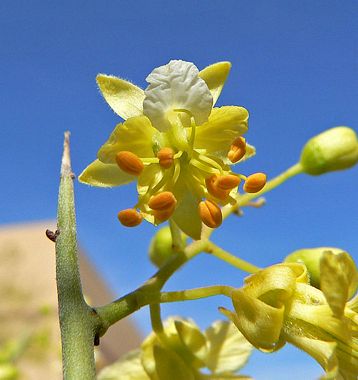
Parkinsonia microphylla (Yellow Palo Verde or Foothill Palo Verde) is a rare species in the Fabaceae (Legume) family that is native to the southwestern United States (southeastern California, southern Arizona) and northwestern Mexico (Sinaloa, Sonora, Baja California). The Palo Verdes were previously classified in the genus Cercidium, and some sources may still refer to it by that name. It is a bristling, upright-branching tree, mostly found on rocky slopes. It has a very restricted range compared with other species in this genus, and it is included on CNPS list 4.3. The species is slow-growing, sometimes living for several hundred years. It typically grows to heights of around 5 meter, although rarely it can reach 6-7 meter tall. Like others in the genus it has chlorophyll in the bark which allows photosynthesis to continue when the tree is leafless. It also has spines on the newer, slender stems. The leaves are yellowish green, very tiny, and during extensively dry and hot periods the tree will shed them. The flower is yellow or cream colored and typical of the genus. The fruit is a typical Legume seed pod. Like other Palo Verdes, it is an important tree for wildlife.
Tree
8 - 16 ft Tall
12 ft Wide
Moderate, Slow
Summer Semi-deciduous
None

Cream, Yellow, Green
Spring
Hedge
Full Sun
Low, Very Low
Max 1x / month once established
Easy
Fast
Sandy or rocky, decomposed granite.
Can be pruned to shape at any time, but caution should be used due to the spines
By seed
8*, 9*, 10, 11, 12*, 13*, 14*, 15, 16, 19*, 20*, 21*, 22, 23
Desert slopes to around 3, 000 ft.
Creosote Bush Scrub
Good companions could include Desert Agave (Agave deserti), Elephant Tree (Bursera microphylla), Desert Lavender (Condea emoryi), Brittlebush (Encelia farinosa or actonii), Barrel Cactus (Ferocactus cylindraceus), Ocotillo (Fouquieria splendens), Chuparosa (Justicia californica), Desert Ironwood (Olneya tesota), Joshua Tree (Yucca brevifolia), Mojave Yucca (Yucca shidigera), and numerous species of cactus and desert annuals
Butterflies and moths supported
0 confirmed and 3 likely