

Carried by 10 nurseries
View Availability at NurseryData provided by the participants of the Consortium of California Herbaria
View additional distribution information on the Jepson eflora
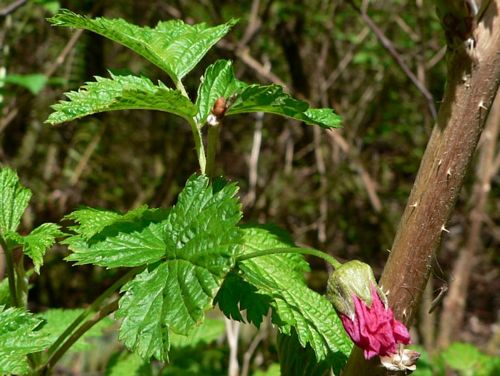
Rubus spectabilis (Salmonberry) is a species in the Rose family native to the west coast of North America from west central Alaska to California. In California it is found primarily along the coast from Santa Cruz County northward, typically in moist areas under tree canopy. It is a shrub growing to 1-4 meter tall, with perennial, not biennial woody stems (unlike other species). It forms large, dense patches given favorable conditions. The leaves are trifoliate, 7-22 centimeter long, the terminal leaflet larger than the two side leaflets. The leaf margins are toothed. The flowers are 2-3 centimeter diameter, with five purple petals; they are produced from early spring to early summer. The fruit, which is edible, matures in late summer to early autumn and resembles a large yellow to orange-red raspberry 1.5-2 centimeter long with many drupelets.
Its spines are less menacing than others in the Rubus genus, making it more suitable for the garden. However, it tendency to spread means that it needs plenty of room. Its deep, rhizomatous root growth makes it a useful plant for bank stabilization
Shrub
3 - 13 ft Tall
30 ft Wide
Upright, Mounding, Spreading
Moderate
Winter Deciduous

Purple
Spring, Winter
Hedge
Deep Shade
Low, Moderate
Max 1x / month once established
Tolerates cold to -5° F
Fast, Medium, Slow
Tolerates sandy or clay soils as long as moisture is adequate.
Soil PH: 5.0 - 7.2
For propagating by seed: 3 mos. stratification may give satisfactory germination. Soaking in either 1% sodium hypochlorite (household bleach) 7 d ays, or concentrated H2S04 20-60 mins., then 3 mos. warm (diurnal fluctuation from 68° to 86°F) and 3 mos. cold stratification may improve germination ( USDA Forest Service 1974). Easily propagated from stem cuttings.
4*, 5*, 6, 7, 15*, 16*, 17*
Moist places
Mixed Evergreen Forest, Forest, Wetland-Riparian
Often grows with:
Trees - Red Alder (Alnus rubra), Western Hemlock (Tsuga heterophylla), Douglas-fir (Pseudotsuga menziesii), Western Redcedar (Thuja plicata), Sitka Spruce (Picea sitchensis), Coast Redwood (Sequoia sempervirens), Grand Fir (Abies grandis), and Pacific Silver Fir (A. amabilis)
Other Plants - Oregon Grape (Berberis aquifolium), Gooseberry (Ribes spp.), Deer Fern (Blechnum spicant), Bitter Cherry (Prunus emarginata), Western Swordfern (Polystichum munitum), Bracken Fern (Pteridium aquilinum), and Lupine (Lupinus spp.)
Butterflies and moths supported
2 confirmed and 54 likely
Omnivorous Looper
Sabulodes aegrotata
Brittania Moth
Acleris britannia