

Carried by 12 nurseries
View Availability at NurseryData provided by the participants of the Consortium of California Herbaria
View additional distribution information on the Jepson eflora
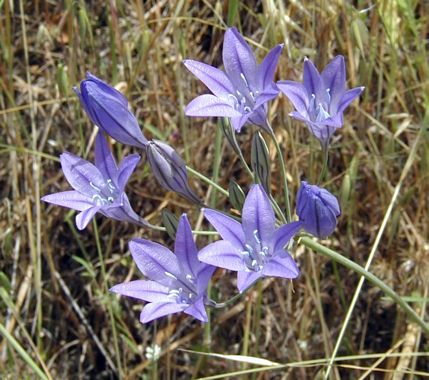
Ithuriel's Spear (Triteleia laxa) is a common native perennial herb in the Lily family that grows primarily in northern and central California. It tends to grow in openings in forest or woodland with sandy soil, at elevations from 0-4600 feet.
Grassy blade-like leaves emerge in late winter and begin to go dormant just before flowering. Loose purple, star-shaped flower clusters arise on foot-long stems in late spring to early summer. Numerous insects including bees and butterflies are attracted to the flowers, and some mammals will dig up and eat the corms.
Extremely easy to grow, Ithuriel's Spear prefers sandy soil but thrives even in clay soil and under native oaks. It can take full sun and will be healthier if allowed to dry out and go dormant in the summer but will survive regular irrigation. Plant the corms 4 inches deep and mass for best effect. It will naturalize over time among other plants or grasses.
Perennial herb, Geophyte
2 ft Tall
6 in Wide
Summer Deciduous

Blue, Lavender, Purple, White
Spring, Summer
Containers
Deep Shade, Partial Shade, Full Sun
Very Low
Max 2x / month once established
Medium, Slow
Does well in sandy soil but can also tolerate clay soil.
The plant is most easily established by planting corms. For propagating by seed: No treatment.
5, 7*, 8, 9, 14*, 15*, 16*, 17*, 19*, 20*, 21*, 22*, 23*, 24*
Open sandy places, meadows; most often in open oak or pine woodland areas.
Chaparral, Foothill Woodland, Mixed Evergreen Forest
Best used with other geopytes such as wild onions (Allium spp.), Mariposa Lily (Calochortus spp.), Dichelostemma spp., and Brodiaea spp.; also with annual wildflowers such as California Poppy (Eschscholzia californica), Clarkia spp., Baby Blue Eyes (Nemophila menziesii), and Chinese Houses (Collinsia heterophylla); and bunch grasses such as California Melic (Melica californica), Small-flowered Melic (Melica imperfecta), Purple-Needlegrass (Stipa pulchera), and Foothill Needlegrass (Stipa lepida).