

Carried by 13 nurseries
View Availability at NurseryData provided by the participants of the Consortium of California Herbaria
View additional distribution information on the Jepson eflora
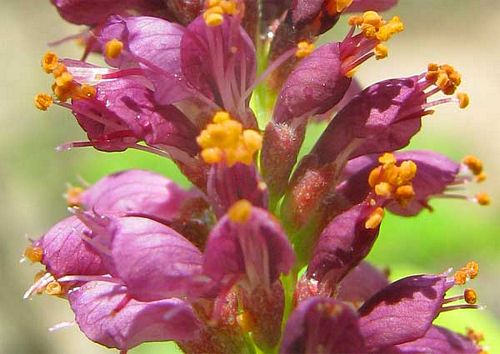
Amorpha fruticosa is a species of flowering plant in the legume family known by several common names, including desert false indigo and bastard indigobush. It is found throughout eastern Canada, northern Mexico, and most of the continental United States. In California it is native to the southwestern part of the state with scattered occurrences in the central valley. A. fruticosa grows as a hairy, thornless shrub which can reach 3 to 4 meters in height and spread to twice that in width. It is somewhat variable in morphology. The leaves are made up of many hairy, oval-shaped, spine-tipped leaflets. The flower cluster is a spike-shaped raceme of many flowers, each with a single purple petal and ten protruding stamens with yellow anthers. The fruit is a legume pod containing one or two seeds.
This plant likes moist (but not saturated) areas, and will spread wherever it finds suitable moisture. It is loosely branched and can become leggy with age; it needs plenty of room to spread out. Its spreading tendency and fibrous root system make it useful for bank stabilization. It is winter deciduous so will be less attractive for several months out of the year. It is the host plant for the Southern Dogface butterfly.
Shrub
6 - 15 ft Tall
Rounded, Fountain, Spreading
Moderate
Winter Deciduous

Purple, Yellow
Spring, Winter
Hedge
Partial Shade, Full Sun
Low, Moderate
Max 1x / month once established
Easy
Tolerates cold to 30° F
Slow
Tolerates a variety of soils.
Tolerates sodic soil..
Soil PH: 7.0 - 8.5
Overly leggy growth can be pruned out in the winter when the plant is dormant
Root divisions or layering.. For propagating by seed: No treatment; scarification may improve germination.
1, 2*, 3*, 6*, 7*, 14*, 15*, 16*, 17*, 18*, 19*, 20*, 21*, 22*, 23*, 24*
Stream edges, canyons, north facing slopes of southern California and scattered locations in the central valley
Chaparral, Coastal Sage Scrub, Wetland-Riparian
It inhabits similar areas to California Wild Rose (Rosa californica). Other companions could include Meadow Rue (Thalictrum fendleri), Snowdrop Bush (Styrax redivivus), Common Snowberry (Symphoricarpos albus), Yellow Monkeyflower (Erythranthe guttata), Western Azalea (Rhododendron occidentale), Brown Dogwood (Cornus glabrata) and Huckleberry (Vaccinum ovatum).
Butterflies and moths supported
4 confirmed and 8 likely
Clay-colored Agonopterix Moth
Agonopterix argillacea
Three-Lined Leafroller Moth
Pandemis limitata
Genista Caterpillar
Uresiphita reversalis
Southern Dogface
Zerene cesonia