

Carried by 2 nurseries
View Availability at NurseryData provided by the participants of the Consortium of California Herbaria
View additional distribution information on the Jepson eflora
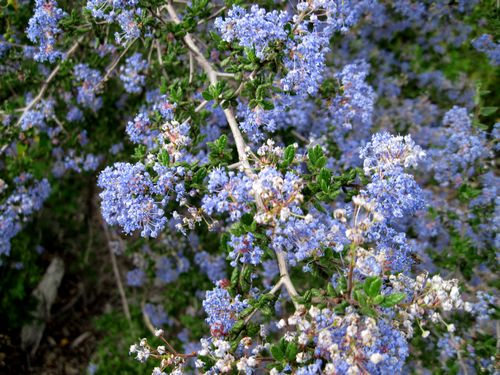
Ceanothus impressus is a species of flowering shrub in the Rhamnaceae (Buckthorn) family known by the common name Santa Barbara Ceanothus. This species is endemic to a small area of the Central Coast of California, where it can be found on coastal slopes and mesas. It is thickly branched with dark brown twigs and stem. The very small, evergreen leaves are about 2 centimeters long and oval shaped, highly ridged and wrinkled and curling under along the edges. They may be gland-dotted and have grayish hairy undersides. The shrub flowers abundantly in flower clusters of small blue flowers. The fruit is a crested spherical capsule about 4 millimeters wide.
There are two recognized varieties that inhabit essentially the same small range. In addition, several popular cultivars are derived from this species including 'Dark Star' and 'Julia Phelps.' This is a great Ceanothus to grow in its natural range. Significant amounts of summer water will kill this plant. It needs the cool coastal climate and strong marine influence to make it through the hot season, so don't try to grow it south of Ventura County or inland areas. Prefers sun or part shade and sandy soils. Makes a great hedge.
Shrub
4 - 6 ft Tall
4 - 6 ft Wide
Rounded
Moderate
Evergreen
Pleasant

Blue
Winter, Spring
Bank stabilization, Hedge
Full Sun
Very Low
Max 2x / month once established
Easy
Tolerates cold to 15° F
Fast, Medium
Sandstone or sandy soil.
Soil PH: 5.0 - 7.0
For propagating by seed: Hot water and 2.5-3 mos.stratification.
5, 7, 8, 9, 14*, 15*, 16*, 17*, 19*, 20*, 21*, 22*, 23*, 24*
Dry, sandy slopes and mesas generally very near the coast
Chaparral
Refugio Manzanita (Arctostaphylos refugioensis), Chamise (Adenostema fasciculatum), Coyote Brush (Baccharis pilularis), Mountain Mahogany (Cercocarpus betuloides), Bush Sunflower (Encelia californica), Yerba Santa (Eriodictyon spp.), Seacliff Buckwheat (Eriogonum parvifolium), Golden Yarrow (Eriophyllum confertiflorum), Laurel Sumac (Malosma laurina), Redberry (Rhamnus crocea), Currant/Gooseberry (Ribes spp.), Sage (Salvia spp.), and Woolly Bluecurls (Trichostema lanatum).
Butterflies and moths supported
0 confirmed and 61 likely
Western Avocado Leafroller Moth
Amorbia cuneana
Common Gray
Anavitrinella pampinaria