

Carried by 11 nurseries
View Availability at NurseryData provided by the participants of the Consortium of California Herbaria
View additional distribution information on the Jepson eflora
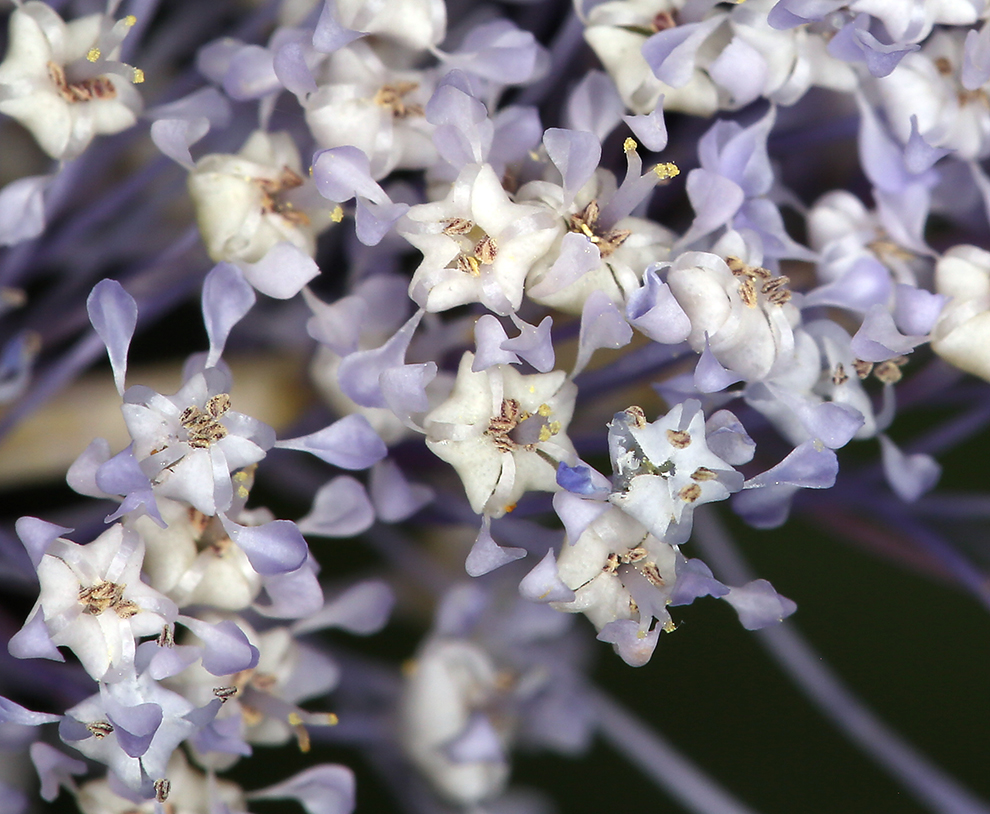
Deer brush (Ceanothus integerrimus) is a woody shrub in the Rhamnaceae (Buckthorn) family native to the western United States, including Arizona, New Mexico, California, Oregon, and Washington. It grows in a wide range of habitats, from chaparral mountain shrub regions to hardwood forests and fir, spruce, and Ponderosa Pine communities, with the most abundance in California's chaparral. The species shows significant variability in form across its range. In some areas, it is a deciduous shrub 1-4 meters tall with an open, ascending to erect branching habit. In others, it is evergreen or semi-deciduous and decumbent. There are two recognized varieties, with overlapping ranges reflecting the species' adaptability.
Deer brush is a drought-adapted shrub that fixes nitrogen through root nodules formed by actinomycete bacteria. It produces fragrant flowers, typically white, though they may occasionally be shades of blue. While it can be tricky to grow in the garden, especially without providing the right conditions, it thrives best in mountain gardens and is particularly suited to growing in the shade of conifers or oaks. The shrub is browsed by wildlife, especially deer.
Shrub
3 - 13 ft Tall
7 ft Wide
Upright, Mounding, Weeping
Moderate
Evergreen, Winter Deciduous, Winter Semi-deciduous
Pleasant

Blue, Lavender, White
Spring, Winter
Bank stabilization
Full Sun
Very Low, Low
Max 2x / month once established
Moderate
Tolerates cold to -10° F
Fast, Medium, Slow
Tolerates decomposed granite or clay.
Soil PH: 4.0 - 7.0
Prune out rangy branches in late summer to maintain a neat appearance and encourage compact growth. For propagating by seed: Hot water and 2.5-3 mos. stratification.
1, 2, 3, 4, 5, 6, 7*, 14, 15*, 16*, 17, 18, 19, 20, 21
Dry slopes, ridges, canyons in the mountainous areas of the state, as part of chaparral, evergreen forest or oak woodland
Mixed Evergreen Forest, Northern Oak Woodland, Yellow Pine Forest
Can be found with a number of different companion plants depending on region of the state, including Manzanita (Arctostaphylos spp.), Scrub Oak (Quercus berberidifolia), Coffeeberry (Frangula spp.), Toyon (Heteromeles arbutifolia), Madrone (Arbutus mezesiesii), Canyon Oak (Quercus chrysolepis), and Ponderosa Pine (Pinus ponderosa).
Butterflies and moths supported
7 confirmed and 84 likely
The Brown Elfin
Callophrys augustinus
Western Tent Caterpillar
Malacosoma californica
California Tortoiseshell
Nymphalis californica