

Carried by 4 nurseries
View Availability at NurseryData provided by the participants of the Consortium of California Herbaria
View additional distribution information on the Jepson eflora
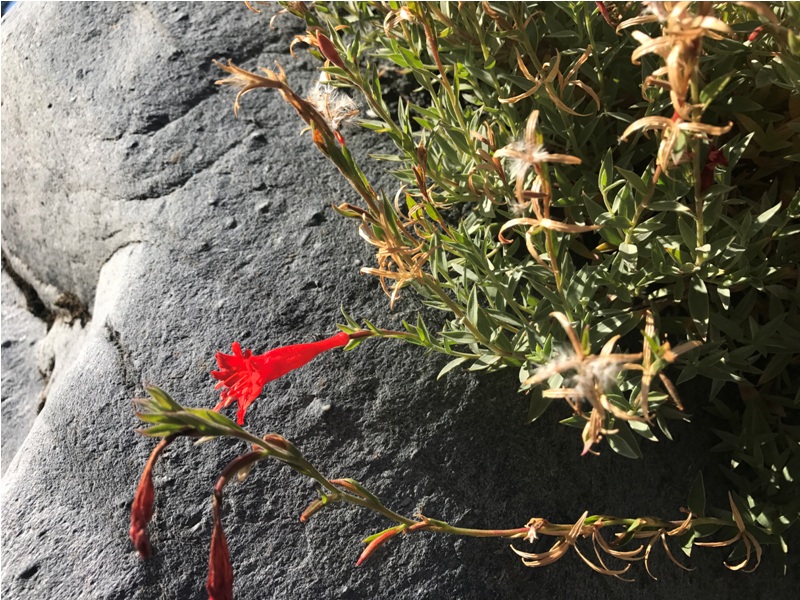
The genus Epilobium in the Onagraceae (Willowherb or Evening Primrose) family includes numerous species. Epilobium septentrionale is a rare species (CNPS list 4.3) known by the common names Humboldt County Fuchsia and Northern Willowherb. Plants in this genus were once treated as members of genus Zauschneria, and some sources still refer to it by that name. This species is endemic to northern California, where it is an uncommon resident of the rocky ledges of the Cascades. It is a squat, clumpy perennial growing in thin patches of soil between rocks and sending up a few erect stems. The leaves are oval and pointed, hairy, and covered in a coat of white fuzz. At the end of each erect branch is a hairy flower cluster bearing a bright red-orange tubular flower 2-3 centimeters long. A bunch of stamens and one long pistil protrude obviously from the mouth of the bloom, which is pollinated by nectar-feeding birds. The fruit is a hairy capsule about two centimeters long. This plant would be a good choice for the north coast garden. For other regions, other species in this genus are available.
Perennial herb
2 - 8 in Tall
2 - 3 ft Wide
Spreading
Moderate
Evergreen

Red, White, Orange
Summer, Fall
Containers, Deer resistant
Partial Shade
Low
Max 1x / month once established
Easy
Tolerates cold to 0° F
Fast, Medium
Tolerates a variety of soils.
Soil PH: 5.0 - 7.0
5*, 7, 14, 15*, 16*, 17*, 19, 20, 21, 22, 23, 24
Dry, sandy or rocky ledges of the mountains of Mendocino, Humboldt, Trinity and Siskiyu Counties, from near sea level to 7, 000 ft.
Douglas-Fir Forest, Mixed Evergreen Forest, North Coastal Coniferous Forest, Forest
Use with other Cascade plants such as Red Alder (Alnus rubra), Manzanita (Arctostaphylos columbiana or stanfordiana), Coast Barberry (Berberis pinnata), Ceanothus spp., Hawthorn (Crataegus douglasii or gaylussacia), Larkspur (Delphinium spp.), Salal (Gaultheria shallon), Crevice Alumroot (Heuchera micrantha), Mock Orange (Philadelphus lewisii), Rosebay (Rhododendron macrophyllum), and Stonecrop (Sedum laxum or spathulifolium)
Butterflies and moths supported
0 confirmed and 8 likely
Black-Banded Carpet
Antepirrhoe semiatrata
Orange Tortrix Moth
Argyrotaenia franciscana
Satyr Pug
Eupithecia satyrata
Gray Pug
Eupithecia subfuscata