

Carried by 31 nurseries
View Availability at NurseryData provided by the participants of the Consortium of California Herbaria
View additional distribution information on the Jepson eflora
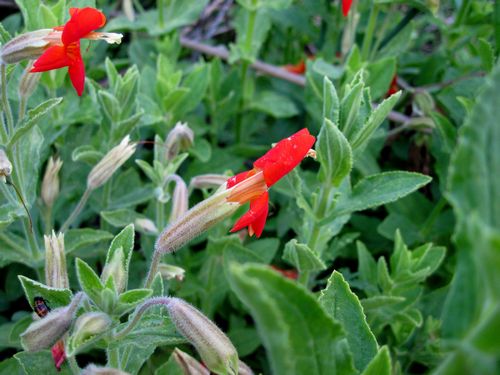
Scarlet monkeyflower is a herbacious perennial in the lopseed family. It is an attractive plant which bears red or orange-red flowers and toothed, downy leaves. It is native to the southwestern United States and Baja California. It is typically found in wetlands or moist areas. It can take full sun but seems to do better with part shade. It is sometimes used as a garden plant for its blooms, which attract hummingbirds. It is a fairly large, spreading, attractive plant which bears strongly reflexed, nectar-rich red or orange-red flowers and toothed, downy leaves. It is native to the West Coast and Southwestern United States and Baja California, and is generally found at low elevation in moist areas. Occasional populations of yellow-flowered Erythranthe cardinalis (which lack anthocyanin pigments in their corollas) are found in the wild.
Erythranthe cardinalis is cultivated in the horticulture trade and widely available as an ornamental plant for traditional gardens; natural landscape, native plant, and habitat gardens; and various types of municipal, commercial, and agency sustainable landscape projects. Cultivars come in a range of colors between yellow and red, including the "Santa Cruz Island Gold" variety, originally collected from Santa Cruz Island off the coast of California.
Perennial herb
2 - 3 ft Tall
3 ft Wide
Upright
Fast, Moderate
None

Red, Orange
Spring, Summer, Fall
Containers, Deer resistant, Water features or wet habitats
Partial Shade, Full Sun
Moderate, High
Keep moist
Easy
Fast, Medium, Slow, Standing
Tolerates sandy and clay soils.
Tolerates serpentine soil..
Soil PH: 4.0 - 9.0
Should be deadheaded to promote flowering and prevent floppy growth
Readily reseeds itself. For propagating by seed: No treatment.
1, 2, 3, 4, 5, 6*, 7*, 8*, 9*, 10, 11, 14*, 15*, 16*, 17*, 18*, 19*, 20*, 21*, 22*, 23*, 24*
Typically found in wetland-riparian areas such as stream banks, bogs, meadows and other moist places over a large part of the state. Often found adjacent to somewhat drier habitats such as evergreen forest, foothill woodlands, chaparral, and grasslands
Chaparral, Foothill Woodland, Lodgepole Forest, Red Fir Forest, Subalpine Forest, Valley Grassland, Yellow Pine Forest, Wetland-Riparian
Other plants that would do well in a moist, partly shaded location include Seep Monkeyflower (Erythranthe guttata), Hedge Nettle (Stachy bullata), Blue Flax (Linum lewisii), Western Columbine (Aquilegia formosa), Douglas Iris (Iris douglasiana), and Stream Orchid (Epipactis gigantea).
Butterflies and moths supported
0 confirmed and 10 likely