

Carried by 5 nurseries
View Availability at NurseryData provided by the participants of the Consortium of California Herbaria
View additional distribution information on the Jepson eflora
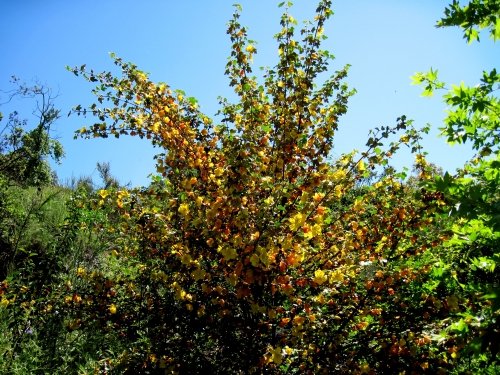
Fremontodendron mexicanum is a rare species of shrub in the mallow family known by the common name Mexican flannelbush. It is known from about ten occurrences in northern Baja California and adjacent San Diego County, California, but it has most recently been confirmed to exist in only two of those locales today. In 1993, fewer than 100 individuals were thought to exist. In the United States it is a federally listed endangered species. The shrub grows in chaparral and coniferous forests among Tecate cypress trees, generally on alluvial plains. It is grown as an attractive ornamental plant in gardens and has occasionally been seen growing in the wild as a garden escapee. It is an erect, flowering shrub or multi-trunked small tree reaching 6-15 feet (1. 8-4. 6 m) high, with branches spreading to 10 feet (3. 0 m) wide. The leathery and furry olive green leaves are up to 5 centimeters long and divided into several wide lobes. The solitary flowers, each about 6 centimeters wide, appear spread along the branches. The showy flowers are made up of five bright orange sepals and have no true petals.
Fremontodendron mexicanum is cultivated as an ornamental plant by specialty plant nurseries, for planting in native plant, drought tolerant, and wildlife gardens, and in natural landscaping and habitat restoration projects.
Shrub
6 - 25 ft Tall
25 ft Wide
Rounded
Fast
Evergreen
None

Yellow, Orange
Spring
Hedge
Full Sun
Low
Never irrigate once established
Tolerates cold to 20° F
Fast
Must be fast draining.
Soil PH: 6.0 - 8.0
Prune in late summer to encourage compact growth. Be sure to wear gloves as the leaf and stem hairs can be highly irritating.
See or cuttings. Most plants available in nursery trade are hybrids, so cuttings are the best way to obtain a reliable result.
Dry sandy washes and slopes, usually within about 20 miles of the coast and below 2, 000 ft. in the southern part of the state, usually as part of the chaparral community. Also occasionally found in association with foothill woodland or pine forest
Chaparral
Tecate Cypress (Hesperocyparis forbesii), Desert Mallow (Sphaeralcea ambigua), Mountain Mahogany (Cercocarpus betuloides), Thickleaf Yerba Santa (Eridictyon Crassifolium), Woolly Bluecurls (Trichostema lanatum), Matilija Poppy (Romneya coulteri), Yucca species, cactus species
Butterflies and moths supported
0 confirmed and 1 likely
Northern White-Skipper
Heliopetes ericetorum