

Carried by 20 nurseries
View Availability at NurseryData provided by the participants of the Consortium of California Herbaria
View additional distribution information on the Jepson eflora
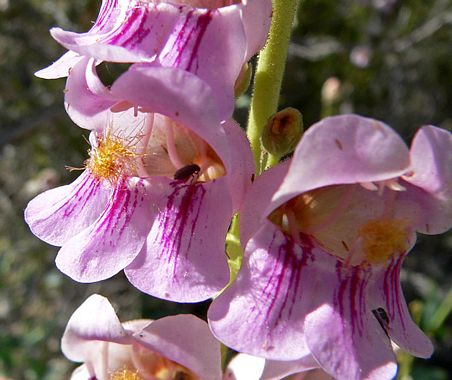
Palmer's Penstemon (Penstemon palmeri) is a member of the Plantaginaceae (Plantain) family, notable for its showy, rounded flowers. This plant grows erect and may reach two meters in maximum height but more often less. The leaves are generally oppositely arranged and have toothed margins. The flower cluster is a panicle or raceme with small leaves. The flower has a five-lobed calyx of sepals and a cylindrical corolla with may have an expanded throat. The flower is pink to blue-purple, and occasional specimens are red, yellow, or white. The staminode is partially hairy. There is one recognized variety, P. palmeri var. palmeri. Both are found in the arid mountains of Inyo and San Bernardino counties.
Perennial herb
4 - 7 ft Tall
2 ft Wide
Upright
Moderate
Evergreen, Summer Semi-deciduous
Pleasant

Purple, Blue, Pink
Spring
Deer resistant
Full Sun, Partial Shade
Low, Very Low
Max 1x / month once established
Moderate
Tolerates cold to -5° F
Fast
Typically sandy or decomposed granite.
Soil PH: 6.0 - 8.0
For propagating by seed: 1-3 mos. stratification.
Slopes washes, canyons and alluvial fans of desert mountains
Joshua Tree Woodland, Pinyon-Juniper Woodland
Use with other high desert plants such as Joshua Tree (Yucca brevifolia), Pinyon Pine (Pinus edulis or monophylla), Utah Agave (Agave utahensis), Bigberry Manzanity (Arctostaphylos glauca), Big Sagebrush (Artemisia tridentata), Desert Ceanothus (Ceanothus greggii), Desert Willow (Chilpsis linearis), Mormon Tea (Ephedra spp.), Buckwheat (Eriogonum spp.), Apache Plume (Fallugia paradoxa), Chaparral Yucca (Hesperoyucca whipplei), California Juniper (Juniperus californica), Bladderpod (Peritoma arborea), Antelope Brush (Purshia tridentata), Sage (Salvia dorrii or mohavensis), Jojoba (Simmondsia chinensis), Banana Yucca (Yucca baccata), and various cactus species.
Butterflies and moths supported
0 confirmed and 7 likely
Variable Checkerspot
Euphydryas chalcedona
Edith's Checkerspot
Euphydryas editha
Common Buckeye
Junonia coenia