

Carried by 22 nurseries
View Availability at NurseryData provided by the participants of the Consortium of California Herbaria
View additional distribution information on the Jepson eflora
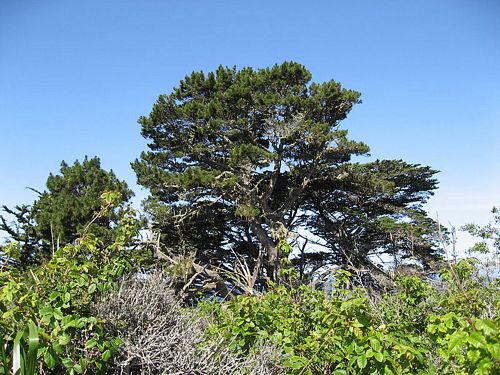
Monterey Pine (Pinus radiata) is a coniferous evergreen tree with upward-pointing branches and a rounded top. It can to 50 to 100 ft in height in the wild but up to 200 ft in cultivation in optimum conditions. The leaves ('needles') are bright green, in clusters of three (two in var. binata), slender, up to 3 inches long and having a blunt tip.
The cones are 3 to 6.5 inches long, brown, ovoid (egg-shaped), and usually set asymmetrically on a branch, attached at an oblique angle. The bark is fissured and dark grey to brown.
This pine is adapted to cope with stand-killing fire disturbance. Its cones are serotinous, that is, they remain closed until opened by the heat of a forest fire. The abundant seeds are then discharged to regenerate on the burned forest floor. Cones may also burst open in hot weather.
It is native to three very limited areas located in Santa Cruz, Monterey, and San Luis Obispo Counties in California, and also to Guadalupe and Cedros Islands in Mexico. Although Monterey Pine is extensively cultivated around the world for lumber, the version of the tree used in the lumber industry is vastly different from the native tree. In its natural state, Monterey Pine is a rare and endangered tree; it is twisted, knotty and full of sap/resin and not suitable for lumber.
In its native range, Monterey Pine is associated with a characteristic flora and fauna. It is the co-dominant canopy tree, together with Cupressus macrocarpa which naturally occurs only in coastal Monterey County.
One of the pine forests in Monterey was the discovery site for Hickman's potentilla (Potentilla hickmanii), an endangered species. Yadon's Rein-orchid (Piperia yadonii), a rare species of orchid, is endemic to the same pine forest adjacent to Pebble Beach. In its native range, Monterey Pine is a principal host for the dwarf mistletoe Arceuthobium littorum. A remnant Monterey Pine stand in Pacific Grove is a prime wintering habitat of the Monarch butterfly.
Grow this plant only along the coast well within the coastal fog bank. In inland areas, it will grow fast if given water but typically dies after around five years. One of the few native plants that the California Invasive Plant Council has determined is invasive in regions outside its natural range. it has invaded coastal scrub, prairie, and chaparral.
Tree
49 - 197 ft Tall
15 - 30 ft Wide
Upright, Pyramidal, Rounded, Upright Columnar
Fast
Evergreen
Pleasant

Yellow, Brown, Cream
Winter
Bank stabilization
Full Sun, Partial Shade
Moderate
Max 2x / month once established
Easy
Tolerates cold to 10 - 20° F
Fast
Prefers sand or sandstone.
Soil PH: 4 - 7
Prune in winter when wood boring insects are less active.
For propagating by seed: Fresh seeds need no treatment; 1 week stratification may improve germination. Stored seeds: 1-3 weeks stratification may improve germination (USDA Forest Service 1974).
Coastal bluffs and dunes, in the coastal fog belt
Closed-cone Pine Forest
Monterey Cypress (Hesperocyparis macrocarpa), Maritime Ceanothus (Ceanothus maritimus), Alumroot (Heuchera micrantha), Twinberry (Lonicera involucrata), Sticky Monkeyflower (Diplacus aurantiacus), Redflower Currant (Ribes sanguineum)
Butterflies and moths supported
10 confirmed and 70 likely
Monterey Pine Needle Miner
Argyresthia pilatella
Orange Tortrix Moth
Argyrotaenia franciscana