

Carried by 44 nurseries
View Availability at NurseryData provided by the participants of the Consortium of California Herbaria
View additional distribution information on the Jepson eflora
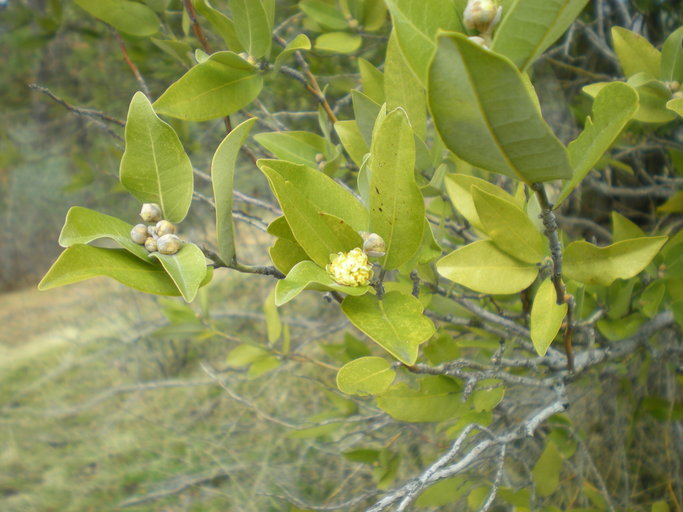
Bay laurel (Umbellularia californica) is an evergreen tree is an attractive tree of variable size, most often 20 to 45 feet. It is slow to establish, then grows fast. The leaves give off a peppery aroma and are often used as a cooking spice. They sometimes turn a spectacular golden color during the autumn in northern California. The flowers are small; white, yellow or yellowish green; and open in late winter and early spring. The fruit is a round, green berry lightly spotted with yellow and purple.
This is one of the few garden trees that tolerates serpentine or clay soils. It is adaptable to various soils and drought tolerant to moderate in water use. It releases terpenes that kill off competing plants, which can somewhat limit understory planting. Protect young plants from browsing deer.
Numerous insects and birds are attracted to the flowers and fruits, with about 4 species of butterfly and moth hosted.
Tree
6 - 80 ft Tall
3 - 30 ft Wide
Upright, Rounded
Moderate
Evergreen
Pleasant

Yellow, Green, Cream, White
Spring
Bank stabilization, Hedge
Full Sun, Partial Shade
Low, Moderate
Max 3x / month once established
Easy
Tolerates cold to 10° F
Medium, Slow
Tolerates a variety of soils including clay and serpentine.
Tolerates serpentine soil..
Soil PH: 5.0 - 8.0
1, 2, 3, 4, 5*, 6*, 7*, 8*, 9*, 14*, 15*, 16*, 17*, 18*, 19*, 20*, 21*, 22*, 23*, 24*
Coastal forests, creek sides, foothills, canyons
Chaparral, Foothill Woodland, Mixed Evergreen Forest, Forest, Yellow Pine Forest, Wetland-Riparian
It releases terpenes that kill off competing plants which can somewhat limit understory planting. California Wild Grape (Vitis californica) is said to work well in the understory. Compatible trees and shrubs include Madrone (Arbutus menziesii), Manzanita (Arctostaphylos spp.), Incense Cedar (Calocedrus decurrens), Ceanothus spp., California Coffeeberry (Frangula californica), Silk Tassel (Garrya elliptica or G. fremontii), Tanoak (Notholithocarpus densiflorus), Yellow Pine (Pinus ponderosa), Douglas Fir (Pseudotsuga menziesii), Oak (Quercus spp.), and Coast Redwood (Sequoia sempervirens).
Butterflies and moths supported
1 confirmed and 3 likely
Western Avocado Leafroller Moth
Amorbia cuneana
Orange Tortrix Moth
Argyrotaenia franciscana
Omnivorous Looper
Sabulodes aegrotata