

Carried by 9 nurseries
View Availability at NurseryData provided by the participants of the Consortium of California Herbaria
View additional distribution information on the Jepson eflora
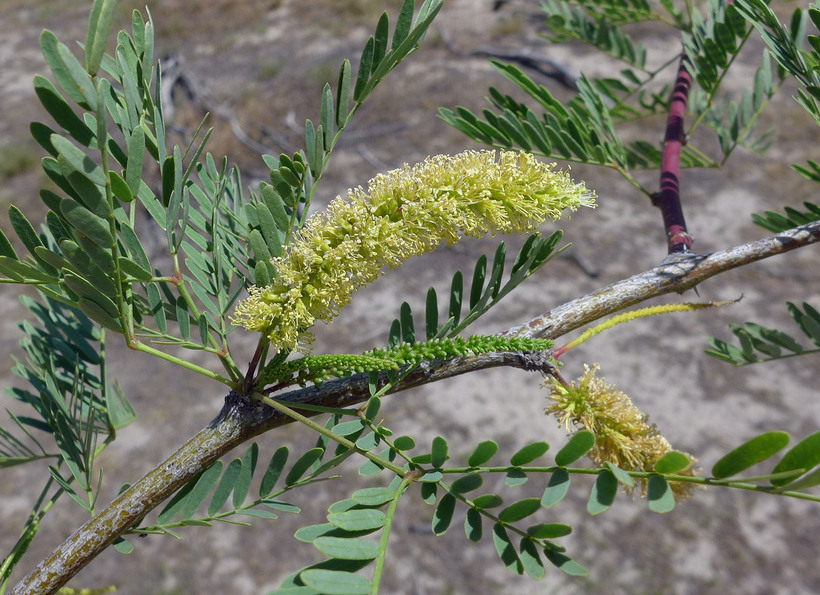
Neltuma odorata, commonly known as Honey Mesquite, is a species of small to medium-sized flowering tree in the legume family, Fabaceae. It is native to the southwestern United States and Mexico, but has been introduced to at least a half-dozen other countries. The IUCN considers it as one of the world's 100 worst invasive species. However, in California's Central Valley and deserts it is an important habitat plant for many species of wildlife. Honey Mesquite has a rounded crown and crooked, drooping branches with feathery foliage and straight, paired spines on twigs. In some settings it will remain a low growing shrub forming dense thickets that are used as refuge by rabbits, quail, and other animals. In other settings it grows as a tree that reaches 20-30 feet, rarely as tall as 50 feet. It is highly adapted to arid environments with a very deep taproot (up to 100 ft.) to reach underground water. The fruit is a nutritious "bean pod" that is valued by many animals and is eaten by Indigenous Peoples of the desert. It has spines and caution should be used when deciding where to plant it. It is an essential plant for the desert wildlife garden.
Tree
20 - 30 ft Tall
30 ft Wide
Winter Deciduous

Yellow
Summer, Spring
Deer resistant
Full Sun
Low
Max 1x / month once established
Easy
Tolerates cold to 10° F
Fast
Typically sand or decomposed granite.
Soil PH: 6.0 - 8.2
Best not to prune if a wildlife thicket is desired. To achieve a tree form, prune in winter to select a main trunk. Use caution in pruning due to sharp spines.
For propagating by seed: Hot water or scarification. Fresh undried seeds No treatment. ( USDA Forest Service 1974).
Flats and washes in arid regions with underground water
Alkali Sink, Creosote Bush Scrub
Use with other desert trees and shrubs such as Desert Agave (Agave deserti), Elephant Tree (Bursera microphylla), Desert Lavender (Condea emoryi), Brittlebush (Encelia farinosa or actonii), Barrel Cactus (Ferocactus cylindraceus), Ocotillo (Fouquieria splendens), Chuparosa (Justicia californica), Beavertail Cactus (Opuntia basilaris), Palo Verde (Parkinsonia spp.), Screwbean Mesquite (Prosopis pubsecens), Smoketree (Psorothamnus spinosus), Joshua Tree (Yucca brevifolia), and Mojave Yucca (Yucca shidigera).
Butterflies and moths supported
8 confirmed and 14 likely
Great Purple Hairstreak
Atlides halesus
Ceraunus Blue
Hemiargus ceraunus
Juno Buckmoth
Hemileuca juno
Marine Blue
Leptotes marina