

Carried by 4 nurseries
View Availability at NurseryData provided by the participants of the Consortium of California Herbaria
View additional distribution information on the Jepson eflora
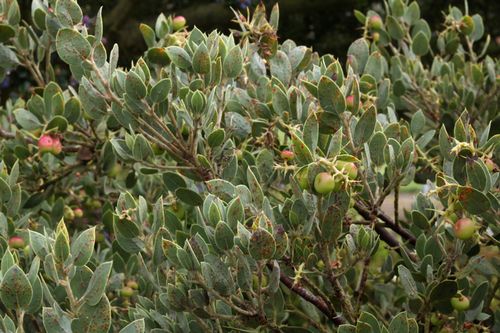
Arctostaphylos obispoensis is a rare species in the Ericaceae (Heath) family known by the common names Serpentine Manzanita and Bishop Manzanita. It is endemic to California, where it is known only from the southern Santa Lucia Mountains of Monterey and San Luis Obispo Counties. For this reason it is included in CNPS list 4.3. It grows in the woodlands and forests of the coastal range, usually on serpentine soil. This is a shrub growing to a height of at least a meter, but known to sprawl to over four meters in height. The small branches and newer leaves are woolly. The mature leaves are hairless and oblong to widely lance-shaped and up to 4.5 centimeters long. The flower cluster is a dense cluster of urn-shaped manzanita flowers. The fruit is a waxy drupe at least a centimeter wide. Despite its rarity, it is a fairly easy plant to grow and good for the central coast.
Shrub
3 - 13 ft Tall
10 ft Wide
Mounding
Moderate
Evergreen

White
Winter, Spring
Full Sun, Partial Shade
Very Low
Max 1x / month once established
Moderate
Tolerates cold to 20° F
Tolerates a variety of soils but prefers serpentine derived soil.
Tolerates serpentine soil..
Soil PH: 6.0 - 7.0
Rocky coastal areas, usually with serpentine soils
Closed-cone Pine Forest
Use with other plants of the central coast, such as Red Alder (Alnus rubra), Yerba Buena (Clinopodium douglasii), Coast Barberry (Berberis pinnata), Ceanothus spp., Giant Chinquapin (Chrysolepis chrysophylla), Wild Strawberry (Fragaria vesca), Monterey Cypress (Hesperocyparis macrocarpa), Crevice Alumroot (Heuchera micrantha), Pines (Pinus spp.), Currant (Ribes malvaceum or sanguineum), Bee Plant (Scrophularia californica), and various annual wildflowers.
Butterflies and moths supported
0 confirmed and 35 likely
Western Avocado Leafroller Moth
Amorbia cuneana
Orange Tortrix Moth
Argyrotaenia franciscana