

Carried by 2 nurseries
View Availability at NurseryData provided by the participants of the Consortium of California Herbaria
View additional distribution information on the Jepson eflora
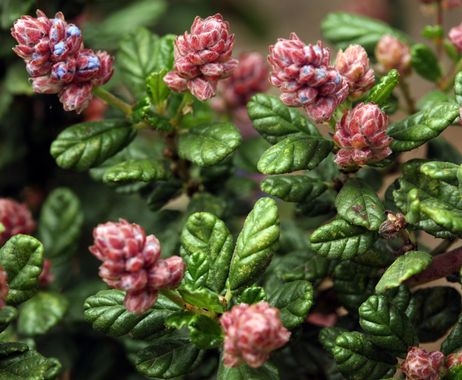
Ceanothus impressus var. nipomoensis is a variety of flowering shrub in the Rhamnaceae (buckthorn) family known by the common name Nipomo Mesa Ceanothus. It is one of two recognized varieties of the species C. impressus. This variety is endemic to the coast of Santa Barbara and San Luis Obispo counties where it can be found on coastal slopes and mesas. It is thickly branched with dark brown twigs and stem. The evergreen leaves are about 2 centimeters long and oval shaped, highly ridged and wrinkled and curling under along the edges. They may be gland-dotted and have grayish hairy undersides. The shrub flowers abundantly in clusters of small blue flowers. The fruit is a crested spherical capsule about 4 millimeters wide.
This is a great Ceanothus to grow in its natural range. Significant amounts of summer water will kill this plant. It needs the cool coastal climate and strong marine influence to make it through the hot season, so don't try to grow it south of Ventura County or inland areas. Prefers sun or part shade and sandy soils. Makes a great hedge.
Shrub
3 - 10 ft Tall
3 - 15 ft Wide
Rounded
Moderate
Evergreen
Pleasant

Blue
Winter, Spring
Bank stabilization
Full Sun
Very Low
Max 1x / month once established
Tolerates cold to 10 - 20° F
Fast
Sandy soils.
Soil PH: 5 - 7
Dry, sandy chaparral slopes of the central coast
Chaparral, Coastal Sage Scrub
Canyon Liveforever (Dudleya cymosa), California fuchsia (Epilobium canum), California Buckwheat (Eriogonum fasciculatum), Coffeeberry (Frangula californica), Chaparral Yucca (Hesperoyucca whipplei), Lupines (Lupinus spp.), Sticky Monkeyflower (Diplacus aurantiacus), Scrub Oak (Quercus spp.), Whiteflower Currant (Ribes indecorum), Cardinal Catchfly (Silene laciniata)
Butterflies and moths supported
0 confirmed and 47 likely
Western Avocado Leafroller Moth
Amorbia cuneana
Common Gray
Anavitrinella pampinaria