

Carried by 13 nurseries
View Availability at NurseryData provided by the participants of the Consortium of California Herbaria
View additional distribution information on the Jepson eflora
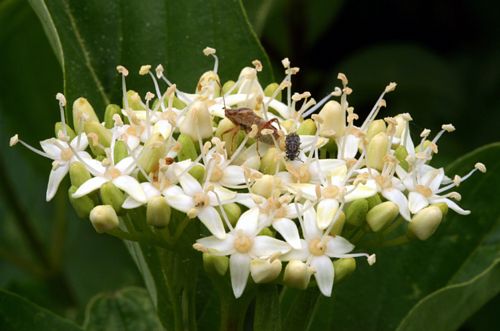
Creek Dogwood (Cornus sericea ssp. sericea) is a native shrub that grows in northern, southern and central California. It was formerly known as Cornus stolonifera and is still referred to by that name in some sources. It is moderately fast growing and moderately long-lived. It grows in a semi-upright form to a height of up to 15 feet, with active growth during the spring and summer. It is noted for its red bark, especially on new growth. Flowers are white and striking, and bloom in the spring. Leaves are medium green and deciduous. Fall foliage is colorful. The fruit is a cluster of small round berries ranging in color from white to gold to blue. It tends to grow in moist places, at elevations from 0-9000 feet.
Creek Dogwood requires moist soil and part shade. It performs best in woodland settings.
Shrub
4 - 15 ft Tall
12 ft Wide
Upright, Spreading
Moderate
Winter Deciduous
Slight

White, Red
Spring
Containers
Partial Shade
High
Max 1x / month once established
Tolerates cold to 0° F
Medium, Slow
Tolerates clay soil.
Tolerates serpentine soil..
Soil PH: 4.0 - 7.0
Prune annually to shape and to stimulate new growth with red stems
From seed, layering or cuttings. For propagating by seed: Soak in concentrated H2S04 1 hr. and 3-4 mos. stratification (USDA Forest Service 1974). 2 mos. warm stratification in lieu of acid bath may give equally good germination. 3 mos. stratification only may also give good germination ( Peterson 1953).
Moist places, creeksides and mountain slopes up to 9, 000 ft. throughout much of the state, as well as extensively outside of California. It is typically found in woodlands in conjunction with firs, pines and other trees
Douglas-Fir Forest, Lodgepole Forest, Red Fir Forest, Wetland-Riparian, Yellow Pine Forest
Trees - Coast Redwood (Sequoia sempervirens), Santa Lucia Fir (Abies bracteata), Duoglas Fir (Pseudotsuga menziesii), and many others.
Shrubs and herbs - Meadow Rue (Thalictrum fendleri), Snowdrop Bush (Styrax redivivus), Yellow Monkeyflower (Erythranthe guttata), Western Azalea (Rhododendron occidentale), and Huckleberry (Vaccinum ovatum).
Butterflies and moths supported
0 confirmed and 41 likely
Forbes' Acleris Moth
Acleris forbesana
Fingered Dagger Moth
Acronicta dactylina
Funerary Dagger Moth
Acronicta funeralis
Triton Dagger Moth
Acronicta grisea