

Carried by 18 nurseries
View Availability at NurseryData provided by the participants of the Consortium of California Herbaria
View additional distribution information on the Jepson eflora
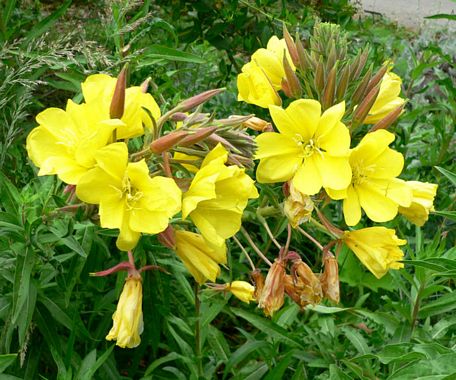
Hooker's evening primrose (Oenothera elata) is a perennial that blooms copiously and is very showy, with large flowers that vary in color from yellow to orange. As with other "evening" primroses, the flowers close up during mid-day. The flower stalks arch up 3 to 5 feet high from a basal rosette of leaves and flowers bloom in the spring and summer of the plant’s second year. The leaf base is usually 1 to 3 feet wide. There are two recognized subspecies, ssp. hookeri and ssp. hirsutissima.
Although this plant is typically found in moist areas in the wild, it is also surprisingly drought tolerant, tough and easy to grow in the garden. Give it full sun or part shade and well-draining soil of any kind. It tolerates virtually any soil. It develops a stout taproot and woody stems with age but can be pruned radically in winter to control ranginess and recovers quickly. It is a prolific seeder, and gardeners will need to be prepared to pull up numerous seedlings from areas where it is not wanted.
A number of insects use this plant, particularly the large Sphinx moths. It hosts a likely total of 15 species of butterfly and moth. Hummingbirds are attracted to the flowers, and smaller birds such as Goldfinches are attracted to the seeds in fall.
Perennial herb
5 ft Tall
3 ft Wide
Upright, Rounded
Fast, Moderate
None

Orange, Yellow
Summer, Fall
Full Sun, Partial Shade
Low
Max 1x / week once established
Easy
Tolerates cold to -20° F
Medium, Slow
Tolerates virtually any soil.
Soil PH: 4.0 - 7.0
Prune in winter to control ranginess. Can be pruned radically and recovers quickly.
Readily from seed
Freshwater wetlands, other moist places, and disturbed places
Coastal Strand, Disturbed Places, Freshwater Marsh, Lakes and Ponds, Mixed Evergreen Forest, Northern Coastal Scrub, Wetland-Riparian
Can be used with virtually any native plant. In a wet garden setting, use with Seep Monkeyflower (Erythranthe guttata), Scarlet Monkeyflower (Erythranthe cardinalis), Stream Orchid (Epipactis gigantea), Yerba Mansa (Anemopsis californica), Hedgenettle (Stachys bullata), and with trees including Willow (Salix spp.), and Cottonwood (Populus fremontii or P. trichocarpa)
Butterflies and moths supported
0 confirmed and 15 likely
Fireweed Clearwing
Albuna pyramidalis
Langston's Forester
Alypia langtoni
Ridings' Forester Moth
Alypia ridingsii