

Carried by 4 nurseries
View Availability at NurseryData provided by the participants of the Consortium of California Herbaria
View additional distribution information on the Jepson eflora
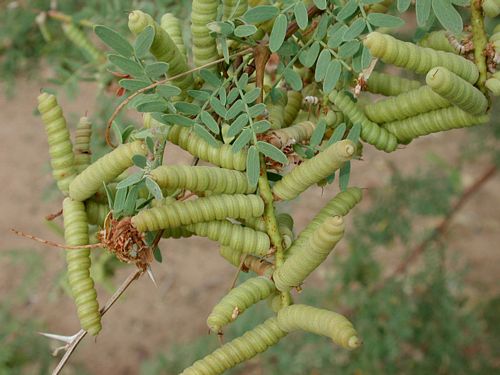
Prosopis pubescens, commonly known as Screwbean Mesquite or Tornillo, is a species of flowering shrub or small tree in the pea family, Fabaceae, that is native to the southwestern United States (Texas, Arizona, New Mexico, California, southern Nevada and Utah) and northern Mexico (Baja California, Chihuahua, Coahuila, Sonora). In California it is found primarily in desert areas from Inyo County southward. It has light brown bark, usually short, straight spines (1-3 centimeter/0.39-1.2 inches), twice-compound leaves, and numerous, small, yellowish flowers appearing in elongate spikes. It is found along streams and valleys in deserts, particularly in damp or saline soil, and grows to about 7 meter (23 feet). It is distinguished from the very similar Honey Mesquite (Prosopis glandulosa) by its tightly twisted seedpods (legumes) which very much resemble turned screws. This morphology may have been an evolutionary defense against seed predators such as bean weevils (Bruchinae). Like Honey Mesquite, these seed pods are valued by wildlife and were eaten by native people.
Tree
10 - 33 ft Tall
20 ft Wide
Upright
Fast
Winter Deciduous

Yellow
Spring, Winter
Bank stabilization, Deer resistant
Full Sun
Low
Max 1x / month once established
Easy
Tolerates cold to 15° F
Fast
Typically sandy or decomposed granite.
Soil PH: 6.0 - 8.0
For propagating by seed: No treatment. Seedlings damp-off very readily. Some lots may need hot water or scarification.
7, 8*, 9*, 10, 11, 12*, 13*, 14*, 15, 16, 18, 19*, 20*, 21*, 22, 23
Creek, river bottoms, sandy or gravelly of the desert
Creosote Bush Scrub, Wetland-Riparian
Use with other desert trees and shrubs such as Desert Agave (Agave deserti), Elephant Tree (Bursera microphylla), Desert Lavender (Condea emoryi), Brittlebush (Encelia farinosa or actonii), Barrel Cactus (Ferocactus cylindraceus), Ocotillo (Fouquieria splendens), Chuparosa (Justicia californica), Beavertail Cactus (Opuntia basilaris), Palo Verde (Parkinsonia spp.), Smoketree (Psorothamnus spinosus), Joshua Tree (Yucca brevifolia), and Mojave Yucca (Yucca shidigera).
Butterflies and moths supported
1 confirmed and 19 likely
Ceraunus Blue
Hemiargus ceraunus
Palmer's Metalmark
Apodemia palmerii
Black Witch
Ascalapha odorata
Great Purple Hairstreak
Atlides halesus