

Carried by 26 nurseries
View Availability at NurseryData provided by the participants of the Consortium of California Herbaria
View additional distribution information on the Jepson eflora
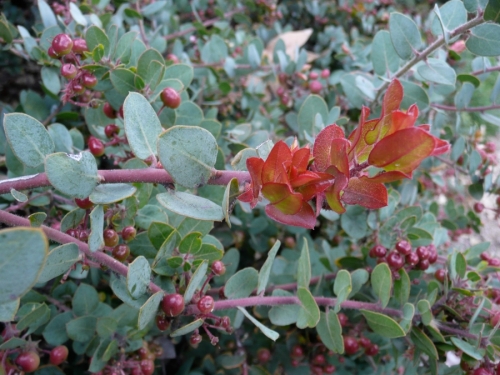
Horticultural selection from Arctostaphylos pajaroensis. Paradise Manzanita is a showy, spreading evergreen shrub and can be used as a border. The bark is a dark red, while the flowers vary from white to pink depending on the climate and soil. If the manzanita is pruned once a year the bright red new growth will cover the shrub and the growth will turn almost purple in the fall. One of the most spectacular things about this manzanita is the fact that is flowers for almost 3 months.
Horticultural selection A. pajaroensis: origin = cuttings from W. Roderick (197?); introduced by suncrest Nurseries 1982. Grows best in sandy, coarse-grained or other fast draining soil. Prefers sun in coastal sites, and sun or part shade in inland sites. Selected for the garden by suncrest Nurseries (Wayne Roderick).
Shrub
6 - 8 ft Tall
6 - 8 ft Wide
Rounded
slow
Evergreen

Pink
Winter, Spring, Summer, Fall
Hedge
Full Sun, Partial Shade
Very Low
Easy
25
Fast
sandy, coarse-grained or other fast draining soils.
Soil PH: 6.0 - 7.0
As needed to shape
In the wild it occurs with a variety of central coast species including Chamise (Adenostoma fasciculatum), Dwarf Coyote Brush (Baccharis pilularis), Blueblossom (Ceanothus thyrsiflorus), Coffeeberry (Frangula californica), Toyon (Heteromeles arbutifolia), Douglas Iris (Iris douglasiana), Twinberry Honeysuckle (Lonicera involucrata), Sticky Monkeyflower (Diplacus aurantiacus), Monterey Pine (Pinus radiata), Black Sage (Salvia mellifera), and Lupines (Lupinus spp.).
Thanks to Moosa Creek Nursery and the Theodore Payne Foundation for sharing information about this plant