

Carried by 9 nurseries
View Availability at NurseryData provided by the participants of the Consortium of California Herbaria
View additional distribution information on the Jepson eflora
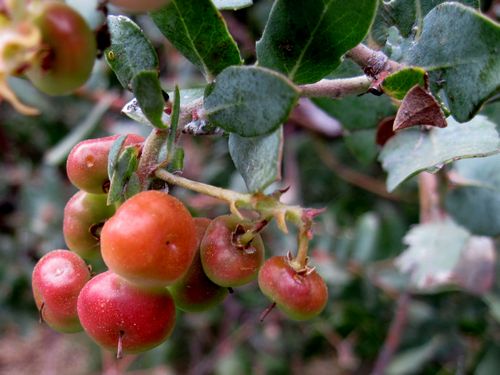
Arctostaphylos pajaroensis is a species of manzanita known by the common name Pajaro manzanita. It is endemic to California, where it is known mainly from Monterey County. Historical occurrences have been noted in Santa Cruz and far western San Benito Counties; these may no longer exist. Most of the extant populations are located in the hills south of the Pajaro River Valley. It is a member of the chaparral plant community. This is an erect shrub growing at least a meter tall and known to exceed four meters in height. It has shreddy red or grayish bark with woolly hairs and long white bristles on its smaller twigs. The dense foliage is made up of gray-green, reddish-tinted leaves with smooth, toothed, or rolled edges. They are oval to somewhat triangular in shape and 2 to 4 centimeters long. The shrub flowers in the winter, bearing large loose flower clusters of pink to nearly white urn-shaped flowers. The fruit is a drupe about 7 millimeters wide.
In the garden its combination of reddish new growth and pink flowers is striking. It can be pruned to ground cover height or allowed to mound up. Though native to the coast, it has performed well in inland gardens with well drained soil in sun to part shade. It has an unusually long bloom time for a manzanita. The horticultural variety 'Paradise' is most often available in nurseries.
Shrub
3 - 15 ft Tall
10 ft Wide
Mounding, Spreading
Moderate
Evergreen
Slight

Pink, White
Winter, Spring
Hedge
Full Sun, Partial Shade
Very Low
Max 2x / month once established
Easy
Tolerates cold to 15° F
Fast
Tolerates clay soil but performs best and lives longest in well drained soil.
Soil PH: 6.0 - 7.0
As needed to shape
Seed or rooted cuttings
Slopes, seaside bluffs as a component of central coast chaparral
Chaparral
In the wild it occurs with a variety of central coast species including Chamise (Adenostoma fasciculatum), Dwarf Coyote Brush (Baccharis pilularis), Blueblossom (Ceanothus thyrsiflorus), Coffeeberry (Frangula californica), Toyon (Heteromeles arbutifolia), Douglas Iris (Iris douglasiana), Twinberry Honeysuckle (Lonicera involucrata), Sticky Monkeyflower (Diplacus aurantiacus), Monterey Pine (Pinus radiata), Black Sage (Salvia mellifera), and Lupines (Lupinus spp.).
Butterflies and moths supported
0 confirmed and 40 likely
Western Avocado Leafroller Moth
Amorbia cuneana
Miranda Underwing
Amphipyra pyramidoides
Fruit-Tree Leafroller Moth
Archips argyrospila