

Carried by 45 nurseries
View Availability at NurseryData provided by the participants of the Consortium of California Herbaria
View additional distribution information on the Jepson eflora
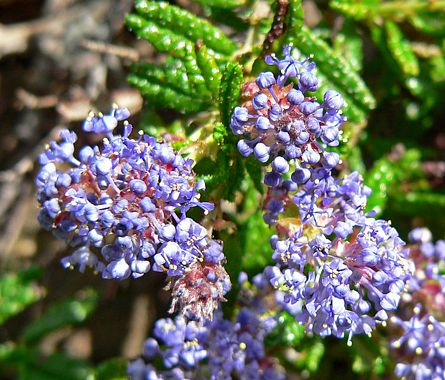
Ceanothus hearstiorum is a species of flowering shrub known by the common names Hearst Ranch Buckbrush and Hearst's Ceanothus. This Ceanothus is endemic to California, where it grows wild only on the hilly coastline of San Luis Obispo County. This shrub is generally wider than it is tall and often lies prostrate in a mat on the ground. The younger branches are hairy and somewhat feltlike in texture. The distinctive evergreen leaves are oval to almost rectangular and have a cupped, rippled surface. The edges are toothed with tiny hairy knobs and the shiny surface may be dotted with more knobs. The underside of the leaf is fuzzy to hairy. The flower clusters are borne on short, stout stalks and the tiny flowers are lavender to blue with prominent yellow-anthered blue stamens.
This plant prefers to be near the coast where it would have cooler temperatures and some fog. If planted inland, give afternoon shade and an occasional rinse in the summer. It is a rare plant in the wild due to its extremely limited distribution. However, it is a popular garden plant and is readily available at nurseries.
Shrub
2 - 12 in Tall
8 ft Wide
Spreading
Moderate
Evergreen
Pleasant

Blue, Lavender
Winter, Spring
Bank stabilization, Deer resistant, Groundcover, Lawn alternative
Full Sun
Low
Max 2x / month once established
Easy
Tolerates cold to 17° F
Fast, Medium, Slow
Tolerates sandy/rocky, clay or adobe soils but not pure beach sand.
Tolerates sodic soil..
Soil PH: 6.0 - 7.5
Prune tips if needed to contain spread
For propagating by seed: Hot water treatment.
Grassy slopes, coastal terraces and bluffs typically overlooking the ocean in northern San Luis Obispo County, as part of coastal prairie, chaparral or coastal sage scrub vegetation.
Chaparral, Coastal Prairie, Coastal Sage Scrub
In the wild it occurs with a variety of central coast species including La Cruz Manzanita (Arctostaphylos cruzensis) which is also a rare species from the same area, Chamise (Adenostoma fasciculatum), Dwarf Coyote Brush (Baccharis pilularis), Blueblossom (Ceanothus thyrsiflorus), Coffeeberry (Frangula californica), Toyon (Heteromeles arbutifolia), Douglas Iris (Iris douglasiana), Twinberry Honeysuckle (Lonicera involucrata), Sticky Monkeyflower (Diplacus aurantiacus), Monterey Pine (Pinus radiata), Black Sage (Salvia mellifera), and Lupines (Lupinus spp.).
Butterflies and moths supported
0 confirmed and 30 likely
Western Avocado Leafroller Moth
Amorbia cuneana