

Carried by 2 nurseries
View Availability at NurseryData provided by the participants of the Consortium of California Herbaria
View additional distribution information on the Jepson eflora
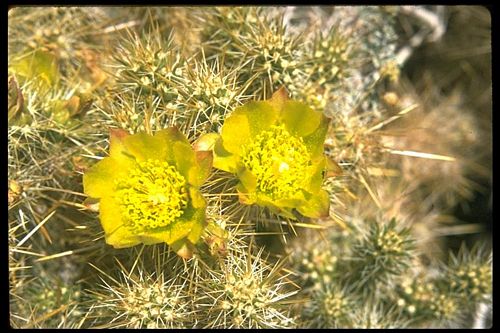
Cane Cholla is one of the most common native species of cholla cactus in California. There are two recognized Varieties: Var. parkeri is found in desert transition chaparral adjacent to the low desert of San Diego County and northern Baja, northward to Santa Barbara County where it grows at elevations from 0-5,200 feet. Chollas tend to hybridize freely, and determinations of species and varieties can be difficult. Var. parkeri is generally distinguished by its erect habit and long, straight segments. The segments are usually 3-5 times longer than wide. The flowers are generally yellow, sometimes with streaks of green or orange. The fruit is dry and inedible.
Shrub, Succulent
5 - 10 ft Tall
5 - 10 ft Wide
Upright
Slow
Evergreen
None

Yellow, Orange, Green
Spring, Summer
Containers, Hedge
Full Sun
Extremely Low, Very Low
Max 1x / month once established
Fast
Sandy or decomposed granite.
Propagation of chollas is best accomplished by detaching segments and planting them in desired locations. Use caution because the spines are formidable.
14, 16, 18, 19*, 20*, 21*, 22*, 23*, 24*
Sandy areas in desert transition chaparral
Chaparral, Coastal Sage Scrub, Yellow Pine Forest
Use with other high desert or desert edge species such as Big Sagebrush (Artemisia tridentata), Desert Agave (Agave deserti), Parish Viguiera (Bahiopsis parishii), Chaparral Whitethorn (Ceanothus leucodermis), Blue Dicks (Dichelostemma capitatum), Calico Cactus (Echinocereus endlemannii), Brittle Bush (Encelia Actonii or farinosa), Buckwheat (Eriogonum fasciculatum var. polifolium), California Juniper (Juniperus californicus), Pinyon Pine (Pinus monophylla), Desert Scrub Oak (Quercus cornelius-mulleri), White Sage (Salvia apiana), Apricot Mallow (Sphaeralcea ambigua), and Mojave Yucca (Yucca shidigera)
Butterflies and moths supported
0 confirmed and 5 likely