

Carried by 6 nurseries
View Availability at NurseryData provided by the participants of the Consortium of California Herbaria
View additional distribution information on the Jepson eflora
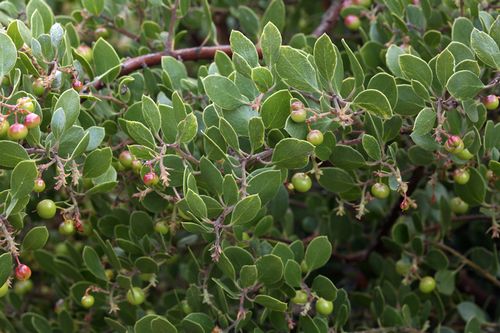
Arctostaphylos rudis is a rare species in the Ericaceae (Heath) family known by the common names Sand Mesa Manzanita and Shagbark Manzanita. It is endemic to California, where it is known only from the southern Central Coast. It is most abundant at Burton Mesa in the hills north of Lompoc, and there are a few occurrences remaining near Nipomo. It grows in chaparral and coastal sage scrub on sandy soils. This is an erect shrub growing from a burl to heights between one and two meters. Its stem and branches are covered in shredding gray and reddish bark, with its smaller branches coated in woolly fibers. The leaves are oval in shape and smooth along the edges with few hairs, green in color and shiny. They are 1 to 3 centimeters long. It flowers in late fall and winter with pink urn-shaped manzanita flowers. The fruits are hairless red drupes about a centimeter wide or slightly larger. Despite its rarity in the wild, it is easy to grow and accepting of garden conditions. It is probably best used near the coast.
Shrub
3 - 7 ft Tall
7 ft Wide
Evergreen

Red, Green, Pink
Spring, Winter
Hedge
Full Sun
Very Low
Max 2x / month once established
Moderate
Tolerates cold to 20° F
Fast, Medium
Prefers sand or sandstone.
Soil PH: 5.0 - 7.0
By seeds or cuttings
Sandy mesas within a few miles of the coast inSan Luis Obispo and Santa Barbara Counties
Chaparral, Coastal Sage Scrub
Use with other central coast species such as Chamise (Adenostoma fasciculatum), Dwarf Coyote Brush (Baccharis pilularis), Blueblossom (Ceanothus thyrsiflorus), Coffeeberry (Frangula californica), Toyon (Heteromeles arbutifolia), Douglas Iris (Iris douglasiana), Twinberry Honeysuckle (Lonicera involucrata), Sticky Monkeyflower (Diplacus aurantiacus), Monterey Pine (Pinus radiata), Black Sage (Salvia mellifera), and Lupines (Lupinus spp.).
Butterflies and moths supported
0 confirmed and 27 likely
Western Avocado Leafroller Moth
Amorbia cuneana
Orange Tortrix Moth
Argyrotaenia franciscana