

Carried by 14 nurseries
View Availability at NurseryData provided by the participants of the Consortium of California Herbaria
View additional distribution information on the Jepson eflora
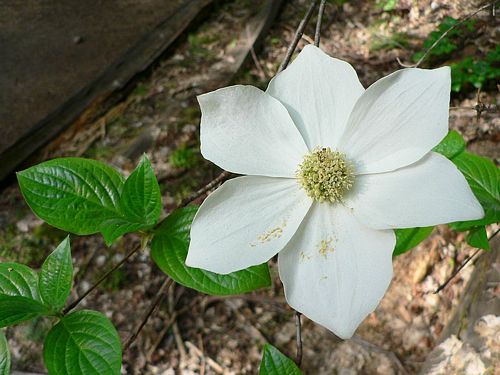
Pacific Dogwood (Cornus nuttallii) is a species of dogwood native to western North America from lowlands of southern British Columbia to mountains of southern California. An inland population occurs in central Idaho. Cultivated examples are found as far north as the Queen Charlotte Islands.
This small to medium-sized deciduous tree often has multiple trunks and and an irregular form. What appears to be its flower is actually a dense, rounded, greenish-white flowerhead composed by myriad tiny flowers; the 4 to 8 large white "petals" are actually leaves. Its fruit is a compound pink-red berry, containing 50-100 small seeds; though edible, it is not very palatable.
With its spectacular white flower arrays, bright green leaves, beautiful autumn foliage, and attractive growth form, Pacific Dogwood is among the more popular native California trees in landscaping applications. It's long-lived and easy to grow when planted in its natural range and in the right site type. It needs to be planted in cool, rich, deep and well-draining soil, in part shade, preferably among smaller companion plants, so as it matures it can reach its branches out into direct sun.
Provide occasional summer water until established; then stop all supplementary irrigation. Avoid disturbing the soil within a few feet of the trunk.
Shrub
12 - 66 ft Tall
6 - 30 ft Wide
Upright
Moderate
Winter Deciduous

Green, White
Spring
Containers
Deep Shade, Partial Shade
Moderate
Never irrigate once established
Moderate
Tolerates cold to -5 - 20° F
Fast
Prefers soil that is cool, moist, deep, well-drained and high in organic matter.
Soil PH: 4 - 7
Prune to an open branching pattern to reduce risk of anthracnose infection.
For propagating by seed: 3 to 4 months stratification. Scarification or first soaking in concentrated H2S04 for one hour may improve germination. Fresh seeds may need no pre-treatment (USDA Forest Service 1948).
1, 2, 4*, 5*, 6, 7, 14, 15, 16, 17, 22, 23
Cool partly-shady areas, with deep, rich, well-draining soil, usually at the edge of forests
Lodgepole Forest, Red Fir Forest, Yellow Pine Forest
Douglas Fir (Pseudotsuga menziesii), Grand Fir (Abies grandis), Western Hemlock (Tsuga heterophylla), Giant Sequoia (Sequoiadendron giganteum), Coast Redwood (Sequoia sempervirens), Pacific Yew (Taxus brevifolia), Western Red Cedar (Thuja plicata), Giant Chinkapin (Chrysolepis chrysophylla var. chrysophylla), Pacific rhododendron (Rhododendron macrophyllum), Oceanspray (Holodiscus discolor), Common snowberry (Symphoricarpos albus), Pacific Bayberry (Morella californica)
Butterflies and moths supported
3 confirmed and 35 likely
Dimorphic Bomolocha
Hypena bijugalis
Western Carpet
Melanolophia imitata
Pearsall's Carpet Moth
Venusia pearsalli
Fingered Dagger Moth
Acronicta dactylina