

Carried by 9 nurseries
View Availability at NurseryData provided by the participants of the Consortium of California Herbaria
View additional distribution information on the Jepson eflora
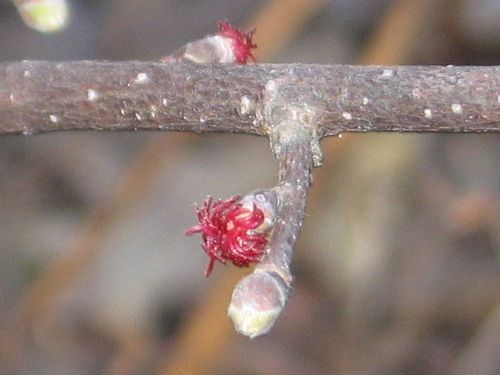
California hazel (Corylus cornuta var. californica) -- also commonly called beaked hazelnut or California hazelnut -- is an evergreen shrub in the Birch family (Betulaceae). Delicate stems are clothed in velvety birch-like leaves which turn golden yellow in autumn. Springtime brings dangling cream-colored catkins before the leaves appear, which can resemble tiny ornaments when viewed from a distance in a forest. Although ruby red, the flowers are quite small, and escape notice unless one is looking for them.
Butterflies and moths are attracted to the flowers and Early Hairstreak butterflies use the plant to lay their eggs. Wild birds feed on the high-protein winter buds and spring catkins. Hazelnuts are famous for their fruit, which is a delicious nut that is enclosed in a papery, beaked-shaped husk. Our native hazelnut, while not as productive as the commercial crop (European Hazelnut, Corylus avellana), may require protection from wildlife if one wishes to grow it for its nuts.
California hazel thrives as an understory shrub or small tree in Woodland habitats, flourishing in part to full shade and slightly moist, well-drained soil near creeks, streams, or under dense tree canopies. Gardeners who are interested in growing their own food using Permaculture or Food Forest methods, can include this plant in the shrub layer. For those who wish to attract wildlife, this is also a wonderful choice. California hazel adds a delicate, ethereal quality to a woodland garden and those with shady yards will find this shrub to be a great addition to their landscapes.
Shrub
5 - 26 ft Tall
10 ft Wide
Upright
Moderate
Winter Deciduous

Red, Yellow
Spring, Winter
Deer resistant
Partial Shade, Deep Shade
Low
Max 2x / month once established
Moderate
Tolerates cold to 0° F
Fast, Medium, Slow
Tolerant of a variety of garden soils as long as sufficient moisture is available.
Soil PH: 5.0 - 7.0
For propagating by seed: 2-3 (and up to 6) mos. stratification; use fresh seeds.
Usually found in openings in various types of woodland or forest
Chaparral, Foothill Woodland, Lodgepole Forest, Red Fir Forest, Valley Grassland, Yellow Pine Forest
Can be used with a variety of woodland and forest plants including:
Trees: Fir (Abies spp.), Red Alder (Alnus rubra), Madrone (Arbutus menziesii), Douglas Fir (Pseudotsuga menziesii), Bigleaf Maple (Acer macrophyllum), Oaks (Quercus spp.), Pines (Pinus spp.), and Bay Laurel (Umbellularia californica).
Shrubs: Buckeye (Aesculus californica), Manzanita (Arctostaphylos spp.), Mahonia (Berberis spp.), Ceanothus spp., Dogwood (Cornus spp.), Coffee Berry (Frangula spp.), and Toyon (Heteromeles arbutifolia)
Butterflies and moths supported
1 confirmed and 44 likely
Polyphemus moth
Antheraea polyphemus
Frosty Dagger Moth
Acronicta brumosa
Funerary Dagger Moth
Acronicta funeralis
habitatdana. (2016, January 18). Beaked Hazelnut, Corylus cornuta. Native Plants PNW. https://nativeplantspnw.com/beaked-hazelnut-corylus-cornuta/
The Lady Bird Johnson Wildflower Center. “Corylus cornuta.” Accessed April 15, 2023. https://www.wildflower.org/plants/result.php?id_plant=coco6.