

Carried by 19 nurseries
View Availability at NurseryData provided by the participants of the Consortium of California Herbaria
View additional distribution information on the Jepson eflora
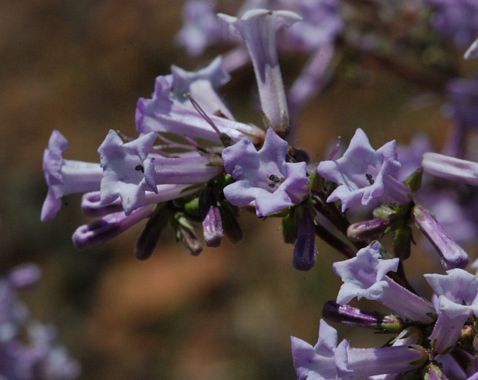
California yerba santa (Eriodictyon californicum) is an evergreen shrub in the Borage family hat grows in central and northern California and parts of Oregon. It is commonly found in chaparral, woodlands, and forested areas, thriving in dry, rocky soils. This hardy plant spreads by underground rhizomes, often forming dense thickets that compete with nearby vegetation.
The plant’s long, narrow leaves, which can grow up to six inches, are coated in a sticky resin and often dusted with black fungi. The leaves emit a strong, bitter scent considered unpleasant by most and are generally avoided by animals. In late spring to summer, California yerba santa produces clusters of small, bell-shaped flowers that range from white to light purple, providing nectar for native pollinators.
Traditionally, this plant is valued for its medicinal uses by Indigenous peoples, including as a remedy for respiratory issues and skin conditions. However, it can be aggressive in the garden, so care should be taken to manage its spread.
Shrub
3 - 10 ft Tall
3 ft Wide
Upright
Fast, Moderate
Evergreen
Unpleasant

Blue, Purple, Pink, White
Spring
Hedge
Full Sun, Partial Shade
Very Low
Max 2x / month once established
Easy
Tolerates cold to 5° F
Fast, Medium
Tolerates a variety of soils as long as good drainage is provided.
Tolerates serpentine soil..
Soil PH: 5.5 - 7.6
7*, 8*, 9*, 14*, 15, 16, 17, 18*, 19*, 20*, 21*, 22*, 23*, 24
Slopes and flats
Chaparral, Foothill Woodland, Mixed Evergreen Forest, Northern Oak Woodland, Forest, Yellow Pine Forest
Grows in the wild with Foothill Pine (Pinus sabiniana), Whiteleaf Manzanita (Arctostaphylos viscida), Hollyleaf Redberry (Rhamnus ilicifolia), Fragrant Sumac (Rhus aromatica), Interior Live Oak (Quercus wislizenii), Mountain Mahogany (Cercocarpus betuloides), Buck Brush (Ceanothus cuneatus), and Blue Oak (Quercus douglasii). In the garden, it can be used with a variety of other chaparral shrubs.
Butterflies and moths supported
4 confirmed and 1 likely
Fruit-Tree Leafroller Moth
Archips argyrospila
The Brown Elfin
Callophrys augustinus