

Carried by 2 nurseries
View Availability at NurseryData provided by the participants of the Consortium of California Herbaria
View additional distribution information on the Jepson eflora
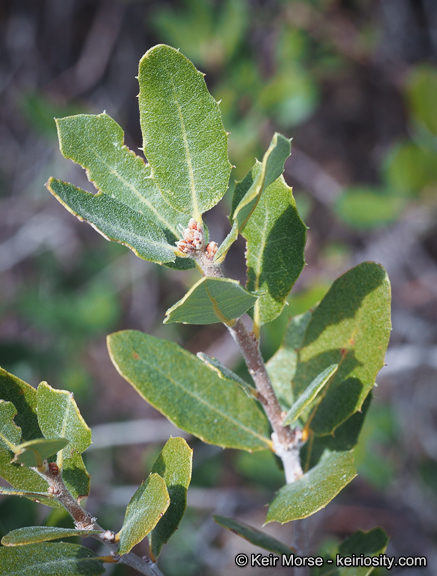
Quercus cornelius-mulleri is a North American species of oak known by the common name Muller oak, or Muller's oak. It was described to science in 1981 when it was segregated from the Quercus dumosa complex and found to warrant species status of its own. It was named for the ecologist Cornelius Herman Muller. It is native to southern California and Baja California, where it grows in chaparral, oak woodlands, and other habitat in foothills and mountains. It can most easily be observed in Joshua Tree National Park and in the woodlands along the western margins of the Colorado Desert in San Diego County, California. Quercus cornelius-mulleri is a bushy shrub not exceeding 3 meters (10 feet) in height. It is densely branched, its tangled twigs gray, brown, or yellowish, fuzzy when new and becoming scaly with age. The evergreen leaves are leathery and thick. They are bicolored: white and quite woolly on the undersides and dull gray- or yellow-green and faintly hairy on the upper surfaces. The wool on the undersides of the leaves is made up of star-shaped leaf hairs that are fused into microscopic plates. The leaf blades are oval with smooth or toothed edges, and measure 2. 5 to 3. 5 centimeters (1. 0-1. 4 inches) in length. The fruit is an acorn with a cap up to 2 centimeters (0. 8 inches) wide covered in light-colored scales and a cylindrical, round-ended nut up to 3 centimeters (1. 2 inches) long.
Shrub
8 ft Tall
Evergreen

Cream, Green
Winter, Spring
Bank stabilization, Hedge
Full Sun, Partial Shade
Low
Moderate
Fast
2, 3, 7*, 8, 9*, 10, 11, 14*, 15, 16, 18*, 19*, 20*, 21*, 22, 23
Slopes, granitic soils
Chaparral, Woodland
Many companion plants including: Coastal Live Oak (Quercus agrifolia var. oxyadenia), Scrub Oak (Quercus berberidifolia), Hollyleaf Cherry (Prunus ilicifolia), Sugar Bush (Rhus ovata), Sourberry (Rhus aromatica), Chaparral Whitethorn (Ceanothus leucodermis), Cup-leaved Ceanothus (Ceanothus perplexans), Chamise (Adenostoma fasciculatum), Red Shanks (Adenostoma sparsifolium), Big Sagebrush (Artemisia tridentata), California Buckwheat (Eriogonum fasciculatum), California Fuchsia (Epilobium canum), Acton Encelia (Encelia actoni), Brittlebush (Encelia farinosa), San Diego Mountain Mahogany (Cercocarpus minutiflorus), White Sage (Salvia apiana), Chia (Salvia columbariae), California Aster (Corethrogyne filaginifolia), Desert Gooseberry (Ribes velutinum), Giant Stipa (Stipa coronata), Chaparral Yucca (Hesperoyucca whipplei), Yucca spp., Cylindropuntia spp., and many other desert species.
Butterflies and moths supported
0 confirmed and 132 likely